US bank profits fall to $84.8 billion: how much of your savings is FDIC-insured?
The latest quarterly banking report shows lower earnings and higher unrealized securities losses. Understand what deposit insurance protects and compare balances at two insured banks.
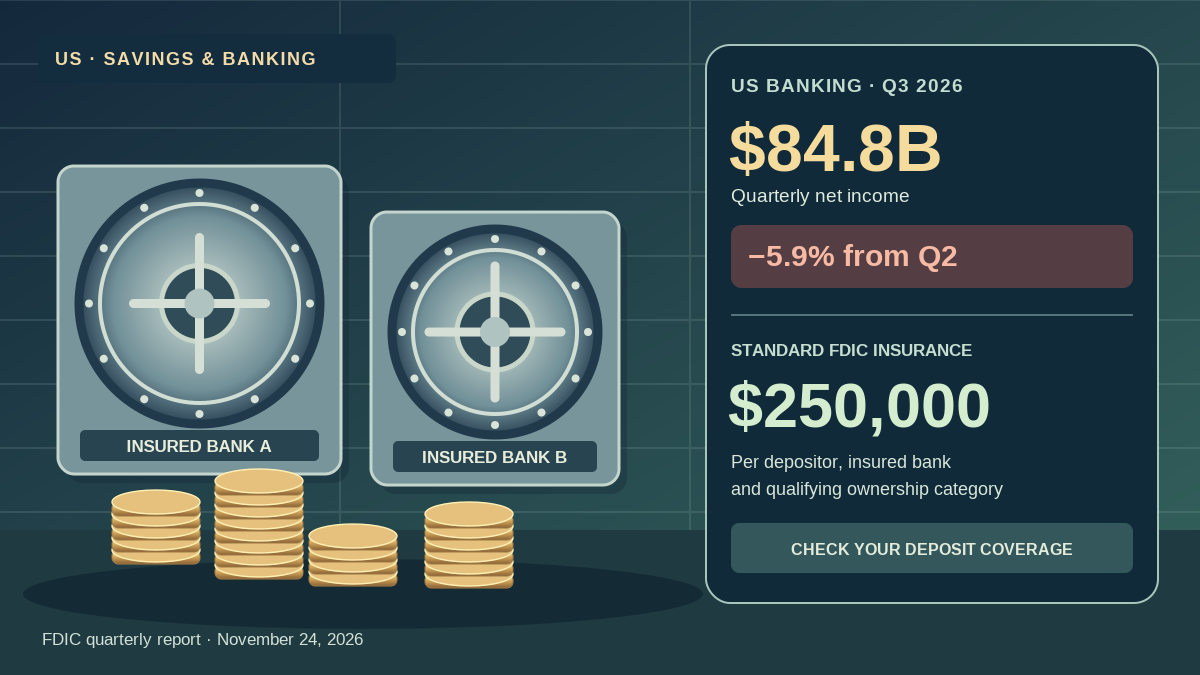
American banks earned less in the third quarter than in the preceding three months, although earnings remained higher than a year earlier. The Federal Deposit Insurance Corporation's November 24 banking report provides a snapshot of the financial position of 4,205 insured commercial banks and savings institutions. Credit Union Daily published further coverage on November 25.
For depositors, the distinction between an institution's profitability and the protection available on an eligible account is important. A quarterly profit decline does not by itself mean a bank is about to fail, and a profitable bank does not give its customers unlimited federal insurance.
What the banking figures show
Reuters attributed the quarterly decline to several factors, including fewer exceptional gains and losses on securities sales. Lending increased, with outstanding loans up 1.9% on the quarter. Domestic deposits continued their nine-quarter run of increases.
Unrealized securities losses reached $486 billion, largely reflecting higher interest rates. When market yields rise, existing fixed-rate bonds generally become less valuable in the secondary market. An unrealized loss describes a reduction in market value; it is not necessarily a completed sale or an equivalent immediate cash outflow. The FDIC reported that industry capital and liquidity remained strong overall. Aggregate findings cannot establish the condition of every institution.
What does deposit insurance cover?
The standard FDIC limit is $250,000 for each depositor at each insured bank, in each qualifying ownership category. Eligible checking accounts, savings accounts, certificates of deposit and money market deposit accounts can receive coverage. Multiple personal single-owner accounts at the same institution do not each receive an independent $250,000 allowance.
Different branches of the same insured bank count as one institution. Separate chartered insured banks may provide distinct coverage. Stocks, bonds and mutual funds are investments, not insured bank deposits, even when purchased through a bank. Deposit insurance protects eligible balances in a bank failure; it is not a general reimbursement policy for scams or investment losses.
Compare single-owner deposits at two banks
This simplified calculator assumes that one individual holds only ordinary single-owner deposit accounts at two distinct FDIC-insured banks. Enter each bank's combined balance, including interest accrued. If both accounts are at the same insured institution, enter their combined balance under Bank A and zero under Bank B.
Total deposits: $400,000.00. Estimated insured: $350,000.00. Above the assumed limits: $50,000.00.
Illustration only. Does not model joint, trust, retirement, business or pass-through coverage, bank mergers or other special rules. Does not verify banks or account eligibility. No data is submitted. Use FDIC's own estimator for your specific circumstances.
Why the distribution of cash matters
| Bank A | Bank B | Above assumed limits |
|---|---|---|
| $400,000 | $0 | $150,000 |
| $300,000 | $100,000 | $50,000 |
| $250,000 | $150,000 | $0 |
| $200,000 | $200,000 | $0 |
All four fictional arrangements hold $400,000. Under the calculator's assumptions, the distribution determines whether any balance exceeds the limit. Leave room for interest if you want to remain within a particular threshold.
Check the legal bank, not just the app name
Some financial technology services provide access to deposit accounts through partner institutions. An app or brand name alone is not proof that a balance is insured. Identify the actual bank and check its status in the BankFind directory. If a service distributes cash across multiple banks, ask how accounts are titled and whether deposits you already hold at those banks count toward the same limit.
Families with joint accounts, trusts or retirement accounts may qualify for different amounts under the applicable ownership rules. Instead of assuming that every account is separately protected, use the FDIC Electronic Deposit Insurance Estimator and contact the agency if the arrangement is complicated. Compare access to money, account fees, interest rates and withdrawal restrictions alongside insurance coverage.
The latest banking results are useful economic context, but they do not change the standard insurance rule. A depositor's next step is to verify the institutions holding their cash and understand which balances qualify.
Sources & further reading
- FDIC — Quarterly Banking Profile
- Compliance Alliance — FDIC release reproduced November 24
- Federal Reserve Bank of St. Louis — November 24 data release
- Reuters via Investing.com — November 24 independent reporting
- Credit Union Daily — November 25 coverage
- FDIC — deposit insurance frequently asked questions
- FDIC — Electronic Deposit Insurance Estimator FAQs
- FDIC — BankFind Suite
AI-assisted, source-based explainer, not individualized financial or legal advice. Reuters' syndicated report was reviewed directly. The FDIC website returned access errors; the release was cross-checked through indexed extracts of its reproduction, St. Louis Fed release data and independent coverage. Deposit insurance rules were checked against indexed FDIC guidance. No bank-specific financial assessment was conducted. Examples are original illustrations. See editorial standards for corrections.