US conforming mortgage limit rises to $855,400 for 2027: calculate your down payment
The FHFA has raised next year's mortgage limits. Find out how the change affects the boundary between conforming and jumbo loans, and calculate the cash needed to stay within a local limit.
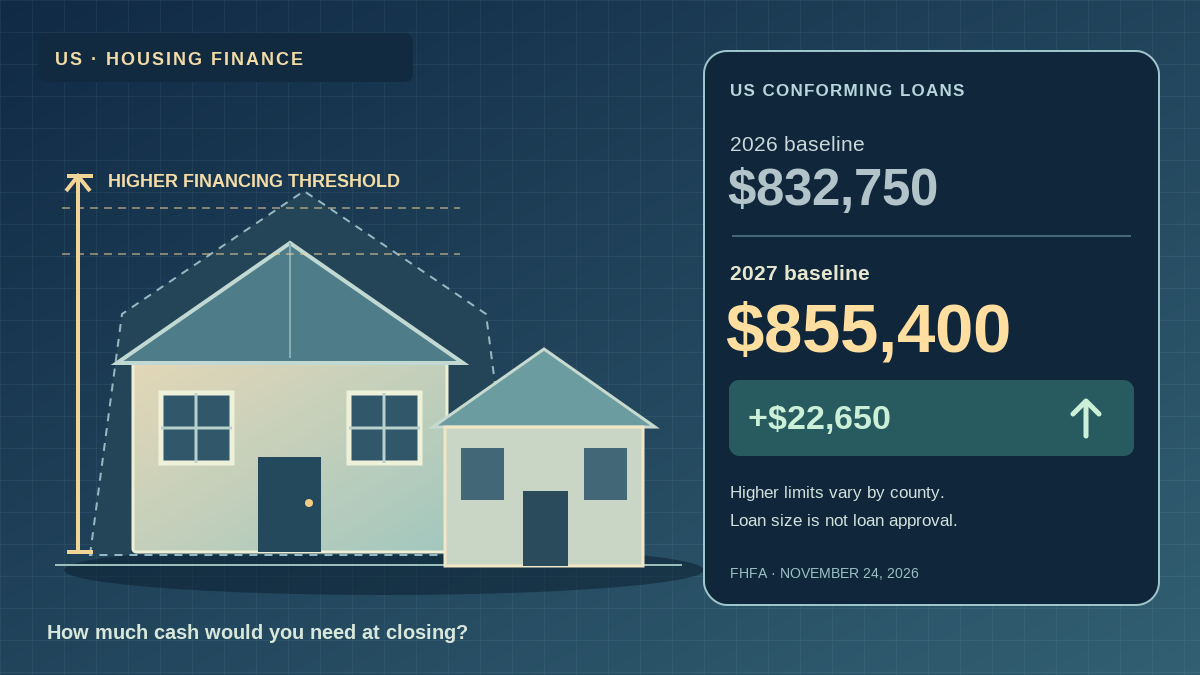
A homebuyer considering an $850,000 mortgage in a county with the standard federal loan limit could have a different set of financing options next year. The Federal Housing Finance Agency (FHFA) announced on November 24 that the baseline threshold will increase from $832,750 in 2026 to $855,400 in 2027. Independent coverage by the Associated Press and HousingWire confirms the change.
The new ceiling matters because Fannie Mae and Freddie Mac can acquire qualifying mortgages within their applicable limits. A loan above the local threshold is generally called a jumbo loan. A larger conforming limit can bring some borrowers into a different segment of the mortgage market without changing the price of the house.
The new thresholds for one-unit properties
| Area or threshold | Loan amount |
|---|---|
| 2026 national baseline | $832,750 |
| 2027 national baseline | $855,400 |
| 2027 ordinary high-cost ceiling | $1,283,100 |
| 2027 special-area baseline | $1,283,100 |
| 2027 special-area ceiling | $1,924,650 |
Source: FHFA. The special-area thresholds concern Alaska, Hawaii, Guam and the US Virgin Islands. A high-cost ceiling is not the actual limit in every expensive county. Use the official county-level data to find the relevant amount for the property and number of units.
Calculate the cash needed to stay within a loan limit
Enter the purchase price, planned down payment and applicable local limit. The tool calculates the remaining mortgage principal, compares it with the threshold, and shows how much extra cash would be needed to meet the size criterion. It assumes the entire purchase price not covered by cash is financed by a single mortgage.
Loan amount: $850,000. Within the entered limit by $5,400. Down payment required by loan size alone: $144,600 (14.46%). Additional cash needed for the size limit: $0.
For illustration only. Does not assess credit, income, appraisal, debt-to-income ratios, mortgage insurance, minimum lender down payments or closing costs. Inputs are processed locally, and the tool does not submit an application.
What changes for a $1 million home?
Using the national baseline and ignoring closing costs, the 2026 loan limit requires at least $167,250 in cash to keep a single loan within that threshold. In 2027 the equivalent amount becomes $144,600. The $22,650 difference is additional potential borrowing capacity, not a government payment or a guaranteed reduction in costs.
A buyer who borrows more must also be able to service the additional debt. A smaller down payment can increase the monthly payment and may trigger mortgage insurance. Conversely, a jumbo lender might offer competitive terms for a particular borrower. Request written quotations for both options when available rather than assuming the conforming loan will always be cheaper.
Why the limits move annually
The agency adjusts the baseline using its statutory house-price methodology. Its latest expanded-data index recorded an increase of 2.72% over the four quarters ending in September 2026. The new baseline rises by approximately that percentage, after rounding. Twenty-four counties or county-equivalent areas will retain their existing limits.
Fannie Mae says the 2027 limits apply to qualifying whole loans delivered from January 1 and to qualifying mortgages delivered into securities pools with issue dates from that date. It also specifies that the relevant amount is the original mortgage principal, not the unpaid balance at a later date. Ask your lender how the timing applies to a planned December or January transaction.
Before increasing your home budget
Set a monthly housing budget first, accounting for property taxes, insurance, maintenance, utilities and association fees where applicable. Keep enough cash available for closing and emergencies. Compare loan estimates using the same term, down payment and rate-lock conditions, and ask which local limit the lender is using.
The federal update changes a financing boundary. It neither establishes how much a particular household can afford nor guarantees loan approval.
Sources & further reading
AI-assisted, source-based explainer, not firsthand reporting or individual mortgage advice. FHFA's announcement and data page, Fannie Mae's notice and AP coverage were reviewed directly; individual county data files were not independently inspected. All calculations are original illustrative scenarios. See editorial standards for corrections.