UK considers AkzoNobel–Axalta merger remedies: what could change for car repair costs?
The competition watchdog is reviewing a proposed sale of a vehicle refinishing business. Understand the implications for body shops and model the effect of paint prices on repair bills.
Britain's Competition and Markets Authority (CMA) said on November 25 that a proposed divestment could address competition issues arising from AkzoNobel's planned acquisition of Axalta. Reuters describes the wider transaction as a proposed $25 billion merger. The latest UK decision is preliminary: the regulator has not yet granted final clearance.
The concern is not about every type of paint sold in Britain. It centres on the specialist coatings used to refinish vehicles after damage or during restoration. Those products form part of the supply chain behind accident repair estimates and cosmetic bodywork.
What the companies have offered
AkzoNobel has proposed selling its vehicle refinishing operation across the UK, European Economic Area and Switzerland. A buyer would need regulatory approval. The sale would include the resources required to operate the divested business, rather than simply transferring a brand name.
After consultation on the package and the potential buyer, the CMA will decide whether the commitments sufficiently preserve competition. The companies' joint statement, filed with the US Securities and Exchange Commission, identifies November 18 as the date the package was submitted.
Why paint suppliers matter to repair shops
A body shop purchases more than coloured paint. A refinishing system can include primers, base coats, clear coats, mixing equipment and colour-matching software. Staff need training and consistent processes to deliver an acceptable finish. A cheaper product is not necessarily cheaper to use if it increases preparation time or the likelihood of rework.
The regulator's concern is that reduced supplier choice could weaken competitive pressure and ultimately affect what workshops and motorists pay. That is a prospective risk, not evidence that this announcement has already caused higher prices. The proposed sale is intended to preserve a competing supplier.
Interactive: model a change in paint prices
Enter your current repair-cost breakdown, using either tax-inclusive or tax-exclusive amounts consistently. The default figures and price change are hypothetical. They are not a market survey or a prediction of the merger's effect.
Original repair cost: £600.00
New materials cost: £230.00
New repair cost: £630.00
Change per repair: +£30.00 (+5.00%)
Monthly materials cost change for workshop: +£900.00
Assumes unchanged material consumption, labour, other costs and repair volume, with the full materials-cost change reflected in the modeled repair cost. Actual customer prices depend on supplier contracts, margins, insurance arrangements and taxes. Inputs are processed by this page's script.
Why a 15% paint price rise is not a 15% repair price rise
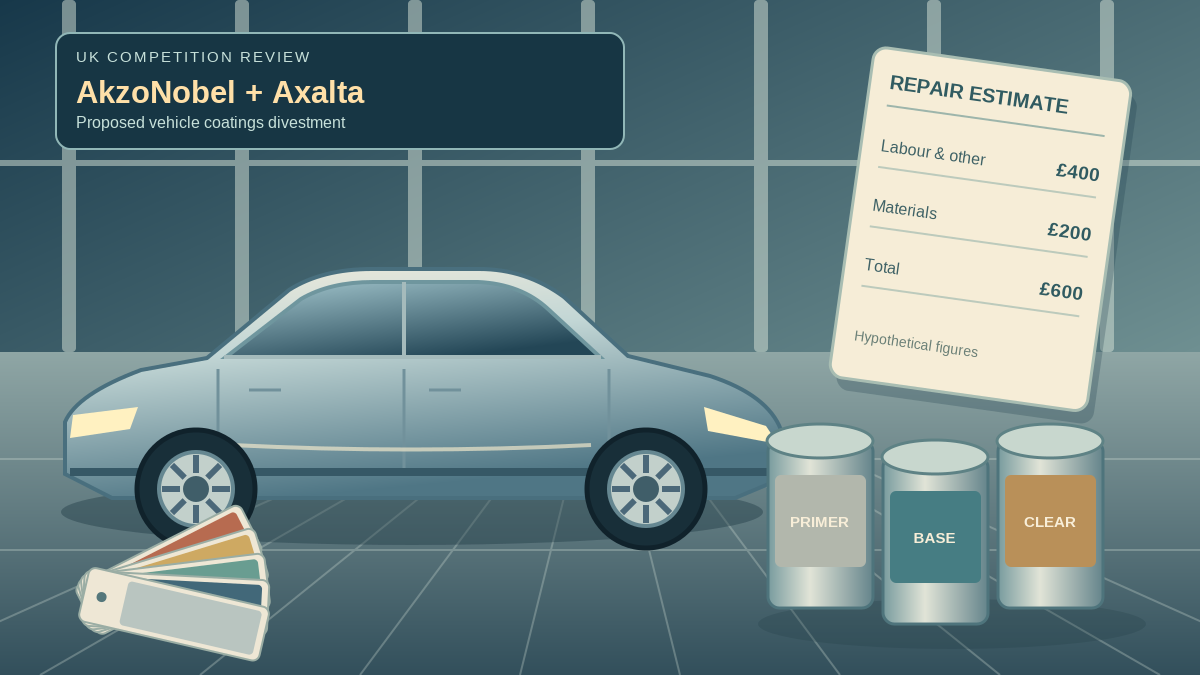
In the fictional example, materials account for £200 of a £600 repair. Increasing the material cost by 15% adds £30. If everything else stays constant, that represents a 5% increase in total cost. A workshop completing 30 identical repairs a month would face an additional £900 of material expenditure.
For a labour-intensive repair, the impact of the same percentage change may be smaller. For a job that requires expensive finishes and multiple panels, it may be larger. A workshop may absorb part of a cost increase, negotiate discounts or revise its pricing rather than passing every additional pound on immediately.
How motorists and workshops can compare offers
Ask for a written estimate identifying the panels involved, preparation, paint work, replacement components and applicable tax. Compare quotes for the same repair scope and finish quality. A low estimate for a localised scratch repair is not directly comparable with an estimate for repainting and blending adjacent panels. If an insurer is paying, check its repair authorisation process and your policy conditions before commissioning work.
Workshops can compare the total cost per completed repair, including labour time, usable material yield, colour-match performance, waste, training and rectification work. Changes in the supplier's price per litre alone do not capture these operational costs.
What happens next?
The important milestones are publication of the consultation, the regulator's assessment of the divestment and its final decision. Until then, the terms of the remedy and timing of completion remain uncertain. The November 25 announcement does not establish a new retail paint price or a change to existing repair contracts.
Sources & further reading
AI-assisted, source-based explainer. No repair prices, supplier contracts or workshop operations were independently surveyed. The calculator is an illustrative sensitivity model, not a forecast. See editorial standards for corrections.