US raises consumer lending and leasing threshold to $76,300 for 2027: what car buyers should know
Federal regulators announced an inflation adjustment on November 25. Compare the 2026 and 2027 thresholds and check what the change could mean for a car loan or lease.
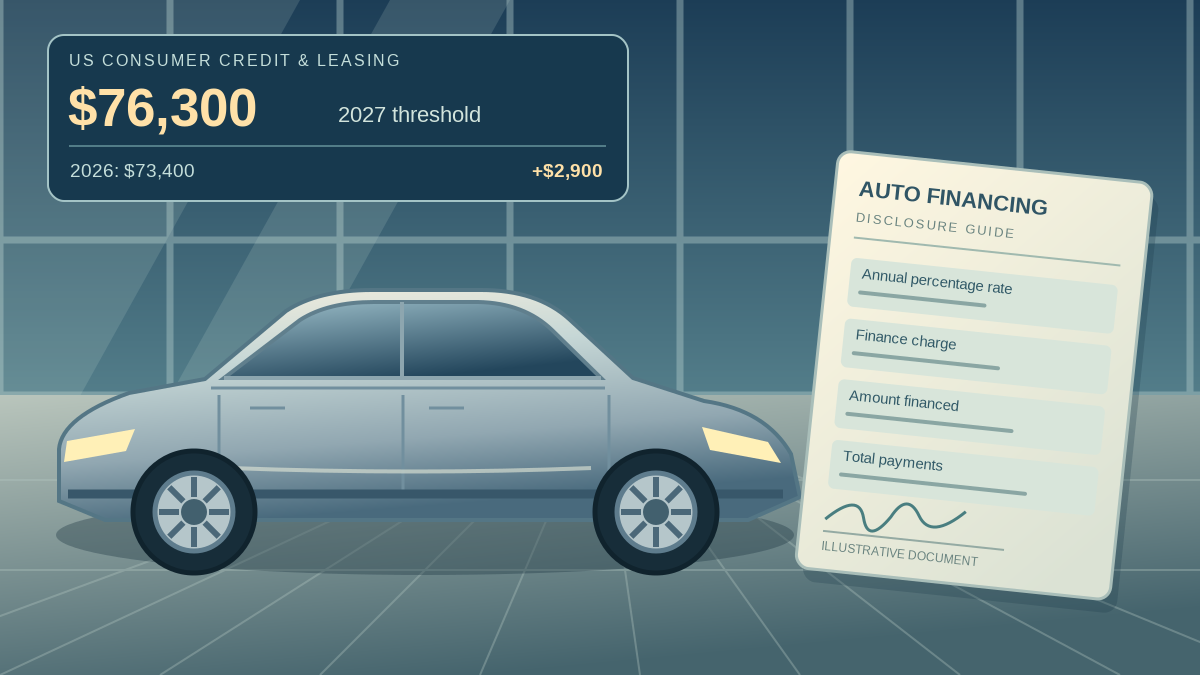
Federal regulators announced on November 25 that the general dollar threshold for certain consumer lending and leasing protections will rise to $76,300 in 2027. The Federal Reserve and Consumer Financial Protection Bureau (CFPB) adjust this figure each year using the CPI-W inflation measure. The latest adjustment follows a 3.9% annual increase in that index.
For someone financing an expensive vehicle, the change can matter because certain transactions that exceeded the old limit will fall within the new one. It is not a maximum legal loan amount or an obligation for a lender to approve an application.
How the threshold changes
Source: Federal Reserve and CFPB. Both bars start at zero and use the same $80,000 scale. The threshold increases by $2,900.
Loans and leases use different measures
Regulation Z implements the Truth in Lending Act, while Regulation M governs qualifying consumer leases. For a conventional closed-end car loan, the relevant comparison is the amount of credit extended, not simply the sticker price of the vehicle. Down payments, trade-ins, taxes and financed add-ons can affect how much is borrowed.
For a lease, the comparison is instead the total contractual obligation as defined by the regulation. That amount may differ from the advertised vehicle price or the disclosed total of payments. The official interpretation explains exclusions, including residual value or purchase-option amounts. A consumer lease generally must run for more than four months and be primarily for personal, family or household use.
Interactive: compare the dollar thresholds
Select an ordinary personal-purpose transaction and enter the relevant dollar amount. If you are unsure of the legally applicable amount, ask the lender or lessor before using the result.
2026: $75,000 exceeds the $73,400 threshold.
2027: $75,000 is within the $76,300 threshold.
The example falls in the newly covered dollar range, assuming all other conditions are met.
Compares the threshold for new transactions in each year. Does not determine full legal coverage, creditworthiness or whether existing contracts change. Inputs are processed locally.
A $75,000 loan illustrates the difference
A hypothetical new $75,000 personal car loan exceeds the 2026 general threshold by $1,600, but is $1,300 below the 2027 limit. This comparison does not establish that any particular dealership contract qualifies. Consumer-purpose credit secured by real property or a principal dwelling, and qualifying private education loans, are exceptions to the general amount-based exemption. Business-purpose credit may be exempt for a different reason.
What to read before signing a car finance agreement
The CFPB's auto financing guidance identifies several disclosures that help consumers compare offers. Look at the annual percentage rate, which incorporates interest and relevant fees; the finance charge in dollars; the amount financed; and the total scheduled repayments. A longer term can reduce the monthly bill while increasing the amount paid overall.
For leasing, compare upfront payments, recurring payments, mileage restrictions, early termination conditions and potential end-of-lease charges. Ask for the full documents and compare offers using the same vehicle and contract term. A transaction above the general threshold does not necessarily lack all legal protections: other federal or state rules and contractual obligations may still apply.
Sources & further reading
AI-assisted, source-based explainer. No specific loan, lease, lender or legal entitlement was evaluated. The checker models only the general dollar exemption and stated exceptions; it is not legal advice. See editorial standards for corrections.