UK confirms new packaging waste fees: how much could a recyclable redesign save?
PackUK has confirmed its 2026/27 disposal fee schedule. Compare packaging weights, per-tonne charges and redesign costs before changing your product packaging.
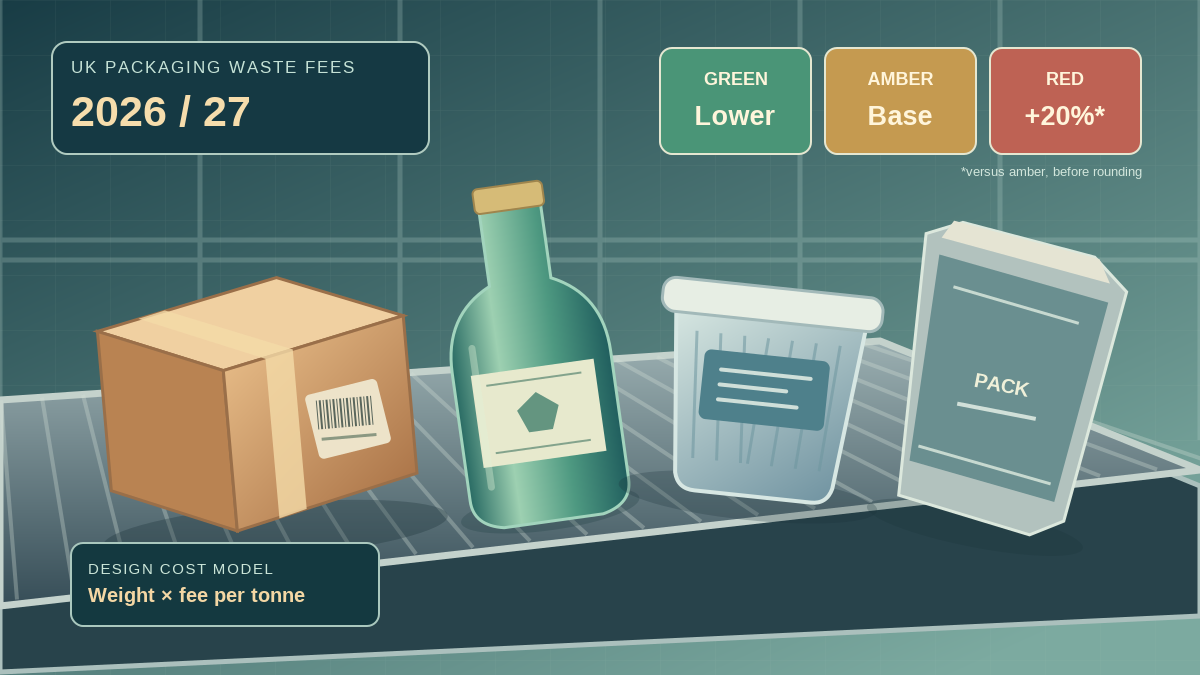
British businesses now have a confirmed waste-disposal fee schedule for the second year of packaging extended producer responsibility (EPR). PackUK published the schedule on November 25. Charges will vary according to how recyclable packaging is assessed to be, making the choice of materials and packaging design more relevant to future budgets.
The change applies to the 2026/27 assessment year, for which the disposal-fee calculations use packaging data from 2025. Businesses should distinguish the imminent bill from any savings they might achieve through future product redesigns: changing a pack today does not retroactively change its historical classification.
What the three ratings mean for disposal fees
Discounted rate
For packaging assessed as more recyclable.
Base rate
The reference rate for that material.
1.2 × base rate
A 20% uplift before rounding for 2026/27.
Source: PackUK's confirmed schedule and modulation policy. Ratings are not assigned by visual appearance; actual rates vary by material.
The additional revenue from the red surcharge funds discounts for green-rated material. A recycling symbol on a label is not sufficient evidence of a green classification. The applicable Recyclability Assessment Methodology (RAM) must be used, including its treatment of packaging components and material combinations.
PackUK says liable businesses will receive notice when their individual liability statement is available. The confirmed material-by-material figures can be consulted in the official 2026/27 schedule. We verified publication of the schedule and the red multiplier, but could not retrieve the complete confirmed table directly. Consequently, this article does not reproduce unverified rates or substitute last year's illustrative figures.
Who needs to check the scheme?
Government guidance classifies a business as a large producer when both its qualifying annual turnover exceeds £2 million and its relevant UK packaging supply exceeds 50 tonnes. The reporting rules include additional tests for corporate groups, the accounting period and the party responsible for the packaging. Some smaller producers have registration and reporting duties even though their obligations differ from those of large producers.
Waste-disposal fees are one part of the scheme. Registration and recycling-note obligations are separate. Before estimating a liability, determine which packaging is household packaging and which exemptions or special rules apply. A business that imports products or sells its own branded goods should not assume its supplier has already accounted for the same packaging.
Calculator: compare two packaging designs
Use the official rates applicable to each material and rating for the period you are modelling. The starting figures are fictional, not PackUK's confirmed charges. This tool models one packaging component at a time.
Current annual packaging weight: 25 tonnes
Proposed annual packaging weight: 22 tonnes
Current disposal fee: £12,000.00
Proposed disposal fee: £7,920.00
Annual disposal fee saving: £4,080.00
Net annual saving after recurring costs: £2,080.00
Simple payback: 2.40 years
One tonne equals one million grams. Excludes tax, other EPR costs, financing, inflation and changes in volumes. Future fee rates may change. This is not a liability assessment. Inputs are processed by the page script locally.
Why weight matters as much as the fee rate
A million packs weighing 25 grams each represent 25 tonnes. Reducing the individual pack to 22 grams lowers the total by three tonnes. In the fictional example, the lower rate and lower weight jointly save £4,080 a year in disposal fees. But a new packaging material costing just 0.2p extra per unit adds £2,000 to annual purchasing costs.
The remaining saving is £2,080 a year. Against a £5,000 tooling and design investment, that implies a simple payback of about 2.4 years. If the supplier's extra charge rises to half a penny per unit, the same fee savings no longer cover it. These numbers demonstrate why a per-tonne discount should not be treated as the project's entire financial return.
A practical redesign process
Start with a component-level inventory: container, lid, label, sleeve, protective inserts and shipping material. Record actual component weights and obtain evidence of the material composition. Use the relevant reporting-year assessment rules to determine classifications rather than assuming that replacing one material automatically improves the rating.
Test protection, shelf life and transport damage before switching. Packaging that saves disposal fees but increases spoiled or damaged goods can produce a worse overall financial and environmental outcome. Obtain supplier quotations at the same order volume and include any manufacturing changes or minimum order quantities.
Finally, separate the current-year liability from future design savings. Use multiple future-rate scenarios and document the assumptions. PackUK's latest publication improves visibility of the present assessment year's fees, not certainty about every future year.
Sources & further reading
AI-assisted, source-based explainer. The November 25 announcement was reviewed directly; the detailed schedule was available through search extracts but its direct fetch failed. The numerical calculator defaults are hypothetical, not official rates. No individual liability or classification was assessed. See editorial standards for corrections.