US jobless claims fall to 189,000: how long would your emergency savings last?
New Labor Department figures show fewer seasonally adjusted unemployment claims ahead of Thanksgiving. Understand the numbers and calculate your household cash runway after a job loss.
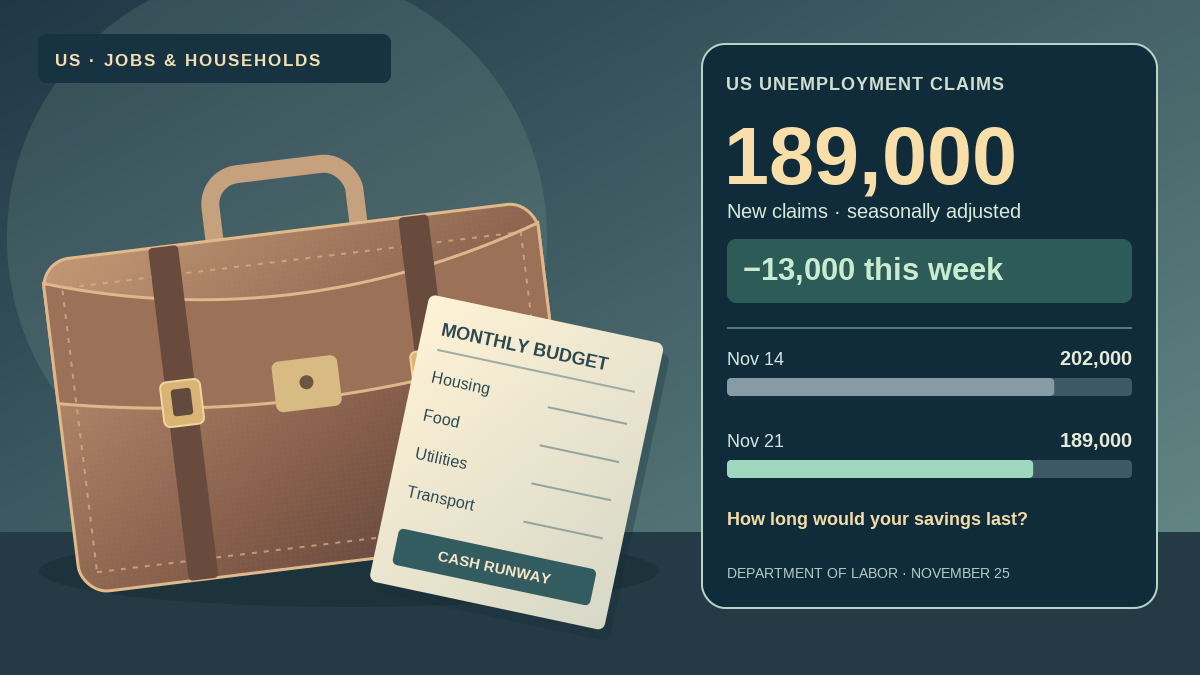
Fewer Americans filed new unemployment insurance claims on a seasonally adjusted basis in the week before Thanksgiving. The Department of Labor's November 25 report recorded 189,000 initial claims for the week ending November 21, down from the revised 202,000 a week earlier. Economists surveyed by Reuters had expected 200,000.
The release arrived on Wednesday instead of the usual Thursday because of Thanksgiving. It offers some reassurance about the pace of new claims, but does not establish that finding a new job has become easier for every worker.
Four numbers to understand
Continuing claims were 95,000 below the preceding week's revised level. Their four-week average, however, increased slightly to 1,724,750. The two measures cover different reporting weeks. Initial claims reflect new applications; continuing claims reflect subsequent weeks of unemployment insurance claims.
Why the unadjusted figures moved in the opposite direction
Source: Department of Labor, November 25 release. Common zero baseline, scale to 250,000.
The actual count rose by 8.1%, but the seasonal adjustment process anticipated a larger increase of 15.5%. Removing predictable calendar-related effects can therefore produce a decline in the adjusted series even when the raw count rises. Weekly figures can also be revised.
Unemployment insurance claims are not a count of everyone without a job. Eligibility and participation affect the figures, and a reduction in new claims does not necessarily imply an acceleration in recruitment. Reuters described a labor market with relatively little hiring or firing. For households, planning for the possibility of interrupted income remains useful.
Calculate your emergency cash runway
Enter accessible savings, essential monthly expenses and reliable monthly income after a hypothetical job loss. The tool estimates how long savings could cover a recurring shortfall.
Monthly shortfall: $1,800.00. Estimated savings runway: 5.0 months. Without the assumed income: 3.0 months.
Fictional defaults. Assumes constant expenses and income, no interest and no unexpected costs. Use after-tax income and count benefits only when reasonably confirmed. The calculator does not establish benefit eligibility or submit your entries.
What to do if benefits arrive late
The default scenario illustrates why timing matters. A household with $9,000 saved and $3,000 in monthly bills could cover only three months without income. If $1,200 in monthly income begins immediately and continues, that rises to five months. A delayed payment or an earlier end to assistance would shorten that estimate.
For a more cautious plan, calculate a second scenario with no benefits. List bills in order of due date rather than treating every month's spending as evenly distributed. Keep an allowance for health coverage, transport and irregular essential bills.
Where to apply for unemployment insurance
USAGov explains that states administer unemployment insurance and set eligibility requirements. In most cases, applicants file in the state where they worked. Prior earnings, the circumstances of separation and job-search requirements can affect qualification. Use the government's state-program directory to reach the relevant agency.
If you have lost employer-sponsored health coverage, review available continuation coverage and other insurance options promptly. The CFPB also advises contacting mortgage servicers, landlords and other creditors before payments are missed to ask about assistance or revised arrangements. Obtain written terms before accepting a payment deferral.
National employment statistics can help describe the economy, but a household's financial resilience depends on its own bills, income and accessible savings. Today's report does not change unemployment benefit eligibility or guarantee an individual worker's job security.
Sources & further reading
- US Department of Labor — weekly unemployment insurance claims, November 25, 2026 (PDF)
- Reuters — November 25 independent reporting
- Reuters report syndicated by Investing.com
- USAGov — state unemployment benefits and application guidance
- CFPB — managing finances after unexpected job loss
- CFPB — emergency savings guidance
AI-assisted, source-based explainer, not individual financial or benefits advice. Department of Labor release text and a reproduced copy were checked against Reuters; PDF screenshot retrieval failed, so the original chart images were not independently inspected. USAGov and CFPB guidance were reviewed directly. Calculations are original illustrative scenarios. See editorial standards for corrections.