US inflation hits 3.8%: what the Fed’s preferred gauge means for your paycheck
October’s PCE report shows price growth still well above the Fed’s long-term goal. Understand the latest data and calculate how inflation could change the value of your paycheck.
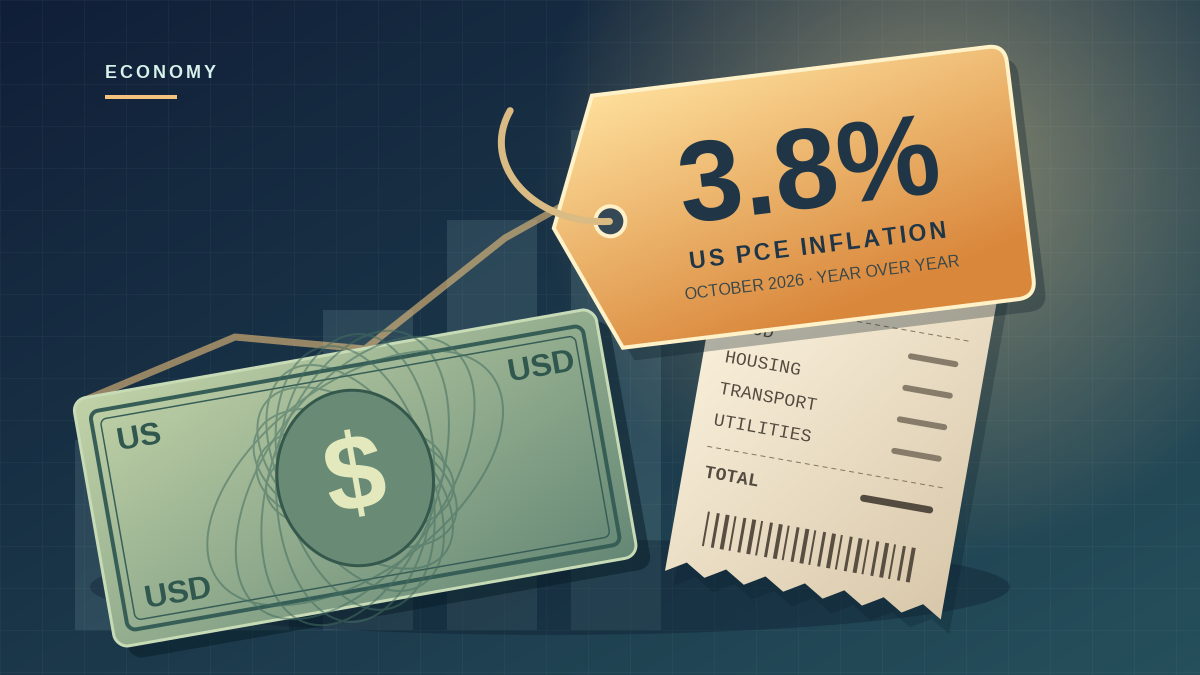
American consumers are heading into the holiday shopping season with another reminder that slower price increases are not the same thing as lower prices. Data released by the Bureau of Economic Analysis (BEA) on Wednesday, November 25, put annual inflation on the personal consumption expenditures (PCE) measure at 3.8% in October.
That matters because the Federal Reserve uses PCE inflation to assess progress toward its 2% longer-term objective. It also provides a useful backdrop for households trying to work out whether their income is keeping up with their expenses.
What the October report tells us
Sources: BEA and Federal Reserve. Common zero baseline; the policy goal applies to overall PCE inflation, not specifically core PCE.
Both the overall and core PCE indexes advanced 0.3% from September. Core inflation, which leaves out food and energy, was 3.3% above its level a year earlier. The latest release also reported a 4.1% personal saving rate.
Americans spent 0.3% more in dollar terms than in September, yet their consumption after adjusting for price changes barely moved. Disposable income adjusted for inflation increased by 0.5%. These are national aggregates: they do not mean everyone received a raise or had more money available to save.
Why PCE and CPI can tell different stories
The consumer price index (CPI), published by the Bureau of Labor Statistics, is another widely followed inflation measure. It is not interchangeable with PCE. The two use different expenditure coverage, weights and calculation methods. For instance, PCE includes some expenses paid on consumers' behalf, including certain health care spending, rather than focusing solely on what consumers pay directly.
The October CPI release came out on November 10. The BLS noted that annual changes for a number of CPI series cannot be calculated because their October 2025 observations are missing. Today's 3.8% reading is from the BEA's PCE series; it is not an October CPI reading. This distinction is particularly important when comparing headlines or checking an inflation-linked contract.
Is your paycheck keeping up with prices?
A useful comparison is to divide your income growth factor by your price growth factor. If both income and prices rise 3.8%, your purchasing power is unchanged under that simplified assumption. A smaller raise leaves you able to buy less, even if your paycheck looks bigger.
For example, a household receiving $4,000 a month would need $4,152 to buy the equivalent of its previous $4,000 basket if the basket became 3.8% more expensive. The following calculator lets you change the starting income, pay increase and assumed inflation rate. It is an illustration, not a forecast or a measure of your actual household inflation.
Paycheck purchasing-power calculator
Calculated on your device. Entries are not saved or transmitted. Assumes the same basket of goods and services over the same period.
Will interest rates go up again?
Higher inflation can put pressure on the Fed to maintain or raise borrowing costs. But a single release does not determine a rate decision: officials also consider the labor market, economic activity and the outlook for prices. The rate on an existing fixed-rate loan generally does not change simply because the Fed changes its policy rate. Variable-rate borrowing and new loans may respond differently.
For households, comparing the actual interest terms on their accounts and reviewing recurring expenses is more useful than assuming a particular central-bank decision. The next BEA income and spending report is scheduled for December 23, when readers will get the November figures.
Sources & further reading
AI-assisted, source-based explainer, not firsthand reporting or personal financial advice. Figures are from the BEA's November 25 release; background is from Federal Reserve and BLS guidance. The calculator is illustrative. See editorial standards for corrections.