America's new penny rounding rules: calculate your cash total under the Common Cents Act
The new federal law establishes a nationwide framework for rounding cash payments. Compare exact and rounded receipt totals and learn what happens to card payments.
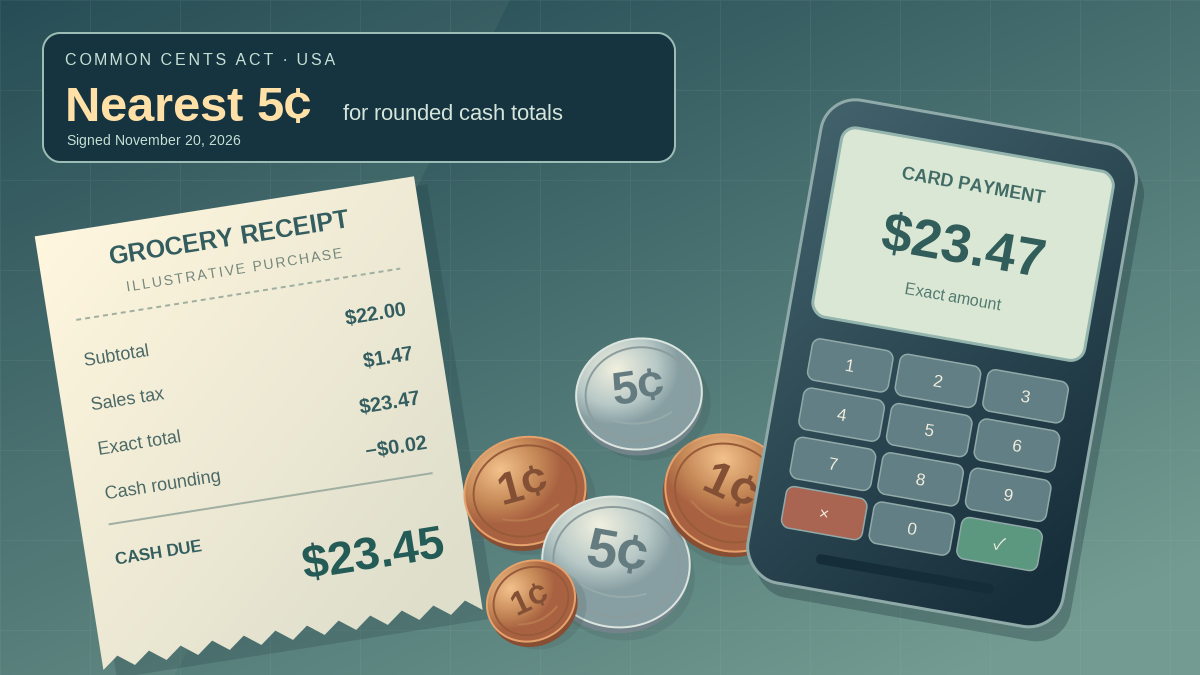
American shoppers may encounter a new way of settling cash purchases this holiday season. On November 25, the National Retail Federation (NRF) published guidance explaining the Common Cents Act, which President Donald Trump signed on November 20. The legislation ends production of pennies for general circulation and provides a federal framework for handling cash transactions as the coins become harder to obtain.
When a retailer uses the permitted rounding method, a cash total can move either upwards or downwards by one or two cents. Electronic payments do not need that adjustment. The distinction is particularly relevant for households comparing receipts during the holiday shopping period.
How a receipt total changes
The following examples demonstrate rounding a final cash total to the closest five-cent increment. The original total includes any applicable taxes and charges. A retailer that can settle the exact amount may continue to do so.
| Final total | Rounded cash | Difference |
|---|---|---|
| $20.00 | $20.00 | None |
| $20.01 | $20.00 | −1¢ |
| $20.02 | $20.00 | −2¢ |
| $20.03 | $20.05 | +2¢ |
| $20.04 | $20.05 | +1¢ |
| $20.05 | $20.05 | None |
| $20.06 | $20.05 | −1¢ |
| $20.07 | $20.05 | −2¢ |
| $20.08 | $20.10 | +2¢ |
| $20.09 | $20.10 | +1¢ |
Illustrative calculations from the rounding convention described by NRF. These are not observed store prices.
Interactive cash rounding calculator
Enter the complete transaction amount, including tax. Choose whether to model a cash purchase rounded to the nearest nickel, exact cash payment, or an electronic payment.
Exact receipt total: $23.47
Amount payable: $23.45
Rounding adjustment: −2¢
Models rounding the whole cash total, not mixed tenders or special payment arrangements. The calculation uses integer cents to avoid floating-point rounding errors. Inputs are processed locally by this page's script.
Small differences can add up — but in either direction
At most, this rounding method changes a single transaction by two cents. A shopper making 100 separate rounded purchases could pay up to $2 more if every one rounded upwards by the maximum amount, or save up to $2 if every one rounded downwards by that amount. Those are mathematical extremes, not expected outcomes.
If the last digit of each receipt total were equally likely to be any digit from zero to nine, the upward and downward adjustments would cancel out on average. Actual shopping totals need not have that distribution. A household buying the same items repeatedly may see similar adjustments on consecutive trips.
Why the new law matters at checkout
Retailers had been developing their own approaches to penny shortages since production stopped in 2025. The new law addresses uncertainty about whether following consistent rounding rules conflicts with other payment requirements. NRF's guidance explains that retailers may choose to round the sales total or the change owed to a customer; it does not describe rounding as compulsory.
For stores, the practical task is to configure tills consistently, explain the policy to customers, and reconcile rounding differences in cash records. For shoppers, the most useful check is to compare the final receipt with the amount actually collected. An adjustment on each individual item would not be equivalent to rounding the final transaction once.
What about the coins you already own?
Ending production for general circulation is different from declaring existing pennies worthless. The signing announcement also allows changes to the materials used for nickels to lower costs. The future composition of a coin is a separate issue from the value used at the till.
If you prefer to avoid a cash rounding adjustment, you can ask whether a retailer accepts exact cash or offers an electronic payment option. Do not assume every store will implement its new checkout process at the same time.
Sources & further reading
AI-assisted, source-based explainer. The law was signed November 20; this article follows the November 25 NRF guidance. The congressional bill page could not be directly retrieved, so the description relies on the official signing confirmation and published guidance. No individual retailer's implementation was tested. See editorial standards for corrections.