UK drinks makers warn over proposed 65% plastic import duty: calculate the potential packaging cost
A proposed UK safeguard on PET resin imports has prompted warnings about food and drink prices. Model the cost of above-quota imports and the possible impact per bottle.
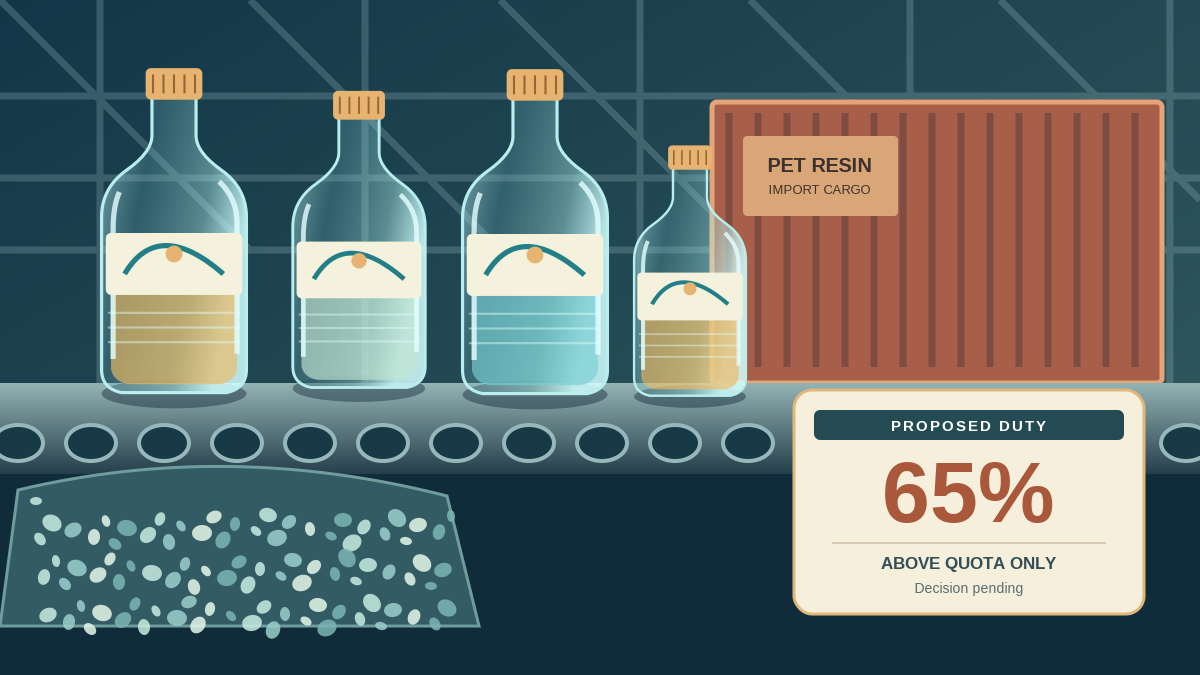
Britain's food and drink manufacturers are pressing the government over a proposed import safeguard on polyethylene terephthalate (PET), a polymer used in bottles and food containers. The Times reported on 25 November that the industry fears the measure could raise production costs and ultimately affect shoppers. The newspaper cited a trade body estimate of more than £200 million in additional food and drink production costs. That is an industry estimate, not an established outcome.
The proposed 65% charge would not apply to every plastic bottle or even every shipment of resin. It would apply to covered imports exceeding the relevant quota under the proposed rules. As of the government's parliamentary answer on 23 November, ministers were still considering whether to implement the provisional recommendation.
How the proposed quota works
The Trade Remedies Authority (TRA) began its investigation in August following an application by Alpek Polyester UK. Its provisional determination was issued on 23 October. The British Plastics Federation (BPF) describes the proposed annualised quota as 192,963 tonnes, with allocations based on origin. The suggested safeguard would cover both virgin and recycled PET resin under commodity codes 3907 61 00 and 3907 69 00, subject to specified country exclusions.
Under the proposal, qualifying imports inside their quota avoid the additional safeguard charge; covered imports exceeding their quota attract a 65% duty. Existing customs charges and other taxes are separate. The suggested start was 1 December 2026, subject to approval, with a provisional measure lasting no more than 200 days. The deadline for consultation responses was 22 November.
Why domestic producers and packaging buyers disagree
The TRA's provisional position is that growth in import volumes has harmed domestic PET manufacturing. A safeguard may offer domestic producers breathing room to adapt. For downstream manufacturers, however, it could raise the cost of imported inputs or reduce access to material from preferred suppliers. Different packaging grades cannot always be substituted without changes to production, testing or sourcing.
The government's public-interest assessment must consider the implications beyond resin production. A parliamentary answer on 23 November said the regulator had assessed effects on importers, downstream firms and consumers, including how those effects could vary across regions and groups. It did not announce approval of the measure.
Interactive: estimate the additional PET duty and cost per bottle
Enter hypothetical figures for a batch of resin purchased directly from overseas. The percentage subject to duty is your own estimate of the covered, above-quota portion. Defaults are illustrative and do not represent current market prices.
Simplified scenario: uniform resin value, no waste, all material used in identical bottles. Excludes VAT, other duties, freight changes, supplier margins and secondary market effects. It does not determine legal quota eligibility or predict retail prices.
A worked example
Suppose a manufacturer imports 20 tonnes worth £1,000 per tonne and six tonnes fall above the relevant quota. A 65% charge on the £6,000 above-quota value adds £3,900. Spread across all 20 tonnes, that is £195 per tonne. If each bottle uses 25 grams, the shipment yields a theoretical 800,000 bottles without production waste. Passing all the extra duty through would add about 0.49 pence per bottle, before other costs.
If none of the shipment is covered by the additional duty, the direct charge is zero. That does not necessarily mean that domestic supplier quotes will remain unchanged. Conversely, a 65% rate on a raw input does not imply a 65% increase in the price of the finished drink.
What importers can do before making purchasing decisions
- Confirm the commodity code and country of origin with your customs specialist, rather than relying on the location of a distributor.
- Identify which purchase contracts allow suppliers to pass through changes in customs charges.
- Request separate quotes for compliant alternative resin grades and include testing, transport and wastage costs.
- Build a cost range using zero, partial and full above-quota exposure instead of assuming every shipment will be charged.
- Monitor the TRA case record and official customs guidance for the final decision and applicable quota arrangements.
For consumers, the most practical response is to compare unit prices for equivalent products. There is no confirmed uniform increase in the price of drinks or ready meals arising from this proposal. Its final scope, implementation and the response of suppliers and retailers remain uncertain.
Sources & further reading
- The Times — 25 November reporting on the food and drink industry's concerns
- Trade Remedies Authority — provisional determination, 23 October
- UK Parliament — government answer on the pending decision, 23 November
- British Plastics Federation — quota, scope and consultation details
- TRA — launch of the investigation, 5 August
AI-assisted, source-based explainer. Status checked 25 November 2026. All calculator examples are fictional, and the proposed measure is not presented as enacted law. Not customs, legal or financial advice. See editorial standards for corrections.