UK announces £49 million for creative industries: how much funding could a games studio match?
New awards support 40 creative technology businesses and five regional research clusters. Explore the funding breakdown and calculate the contribution required for a research project.
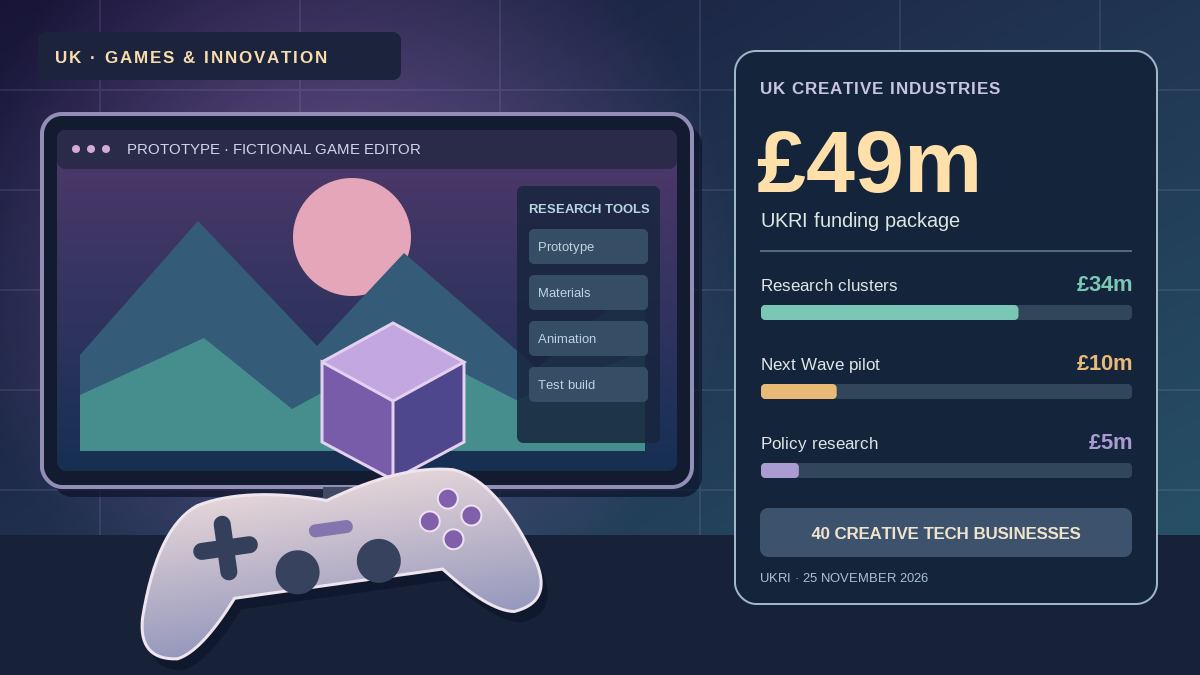
British studios developing new gaming technology are among the winners of a fresh round of government-backed research awards. UK Research and Innovation (UKRI) announced a £49 million package on 25 November at the BEYOND conference in Salford. It includes £10 million for 40 creative technology companies, alongside investment in research partnerships and policy evidence.
The awards cover more than video games: advertising, music and screen production are also represented. The immediate opportunity is for the selected recipients, rather than a new application window for every studio. Other founders can use the published competition rules to understand the kind of research and financial commitment a future application might require.
Where the £49 million goes
Source: UKRI, 25 November. DCMS also announced £2.2 million for the Great North Creative Corridor; that allocation is not part of the £49 million UKRI breakdown shown here.
What counts as creative technology?
The original Next Wave competition targeted industrial research in digital services and platforms. Its eligible fields included games, advertising, screen media and music or visual and performing arts. Simply commissioning another game without a meaningful innovation was outside the competition's scope. A studio might instead investigate a new production method, an accessibility technology or a technical system that enables an experience not currently practical.
GameDev.net, summarising GamesIndustry.biz reporting, identified eight games businesses among the selected recipients, including Huey Games and Ten24 Media. Business News Wales separately highlighted Cardiff's Awkward Studios. The awards are intended to support commercial research, not guarantee the success of the products that emerge.
Calculate the business contribution
The original competition rules capped industrial research grant support at 70% of eligible costs for micro and small organisations and 60% for medium organisations. The calculator assumes a single eligible UK SME, the maximum applicable funding rate, and no exception to the published project-size rules. It also lets you account for expenses not covered by the grant.
Maximum illustrative grant: £140,000. Business match: £60,000. Total own funding including extra expenses: £80,000.
Not an eligibility assessment or a grant offer. The closed 2026 pilot is used as a worked example; future rules may differ. Actual grant rates, eligible costs and payment timing depend on the award. Inputs stay in your browser.
Why the match is not the whole cash requirement
Consider a small studio with a £200,000 research budget and £20,000 in additional expenses. If it receives the maximum grant of £140,000, it still needs £80,000 from other resources. If the award is paid after eligible costs are incurred, it may also need sufficient cash to cover expenses temporarily. A founder should build a month-by-month cash forecast, not just subtract the grant from the budget.
Before committing, identify which staff time, equipment, software and subcontracting expenses are eligible under the actual offer. Set milestones for technical validation and retain evidence of costs. Separate the research budget from ordinary publishing and marketing activities. Do not treat a projected award as cash already received.
Five new research partnerships
The regional investment includes Amgen in Wales, Green Design North, CreateSci in East Anglia, the cross-UK ScreenJourneys initiative and UK Publishing Futures in the North East. The clusters connect creative businesses with research institutions. Their areas of focus range from sustainable design and live performance technology to screen tourism and publishing innovation. Businesses interested in collaboration should contact the relevant project team about actual opportunities rather than assume the entire allocation is available as a direct grant.
Can a new studio apply now?
The first Next Wave competition closed on 11 August 2026, with selected projects expected to begin by 1 January 2027 under the published schedule. Innovate UK Business Connect indicates that a subsequent programme is expected to open in spring 2027. Check its official programme page for a confirmed opening date and the new terms.
There is a discrepancy in today's official summaries: UKRI describes £110,000–£500,000 as grant sizes, while DCMS describes that range as project costs. The original competition rules specify £100,000–£500,000 in eligible project costs. This article uses the original competition terms for its example, not the conflicting descriptions of actual awards.
Sources & further reading
- UKRI — funding announcement, 25 November 2026
- DCMS — government announcement, 25 November
- Innovate UK — original Next Wave competition terms
- UKRI — selected business profiles
- GameDev.net — games industry coverage, 25 November
- Business News Wales — regional coverage, 25 November
- Innovate UK Business Connect — Next Wave programme information
AI-assisted, source-based explainer, not firsthand reporting or grant advice. UKRI, DCMS and the original competition rules were reviewed directly. GameDev.net and Business News Wales coverage and the future programme schedule were checked through indexed extracts. Individual award agreements were not reviewed. The financial illustration is original. See editorial standards for corrections.