US machinery orders rise 1.8%: how to calculate whether new business equipment will pay for itself
The November 25 Census Bureau report shows stronger machinery demand despite slower overall durable goods growth. Compare equipment costs and estimated monthly savings with an interactive payback calculator.
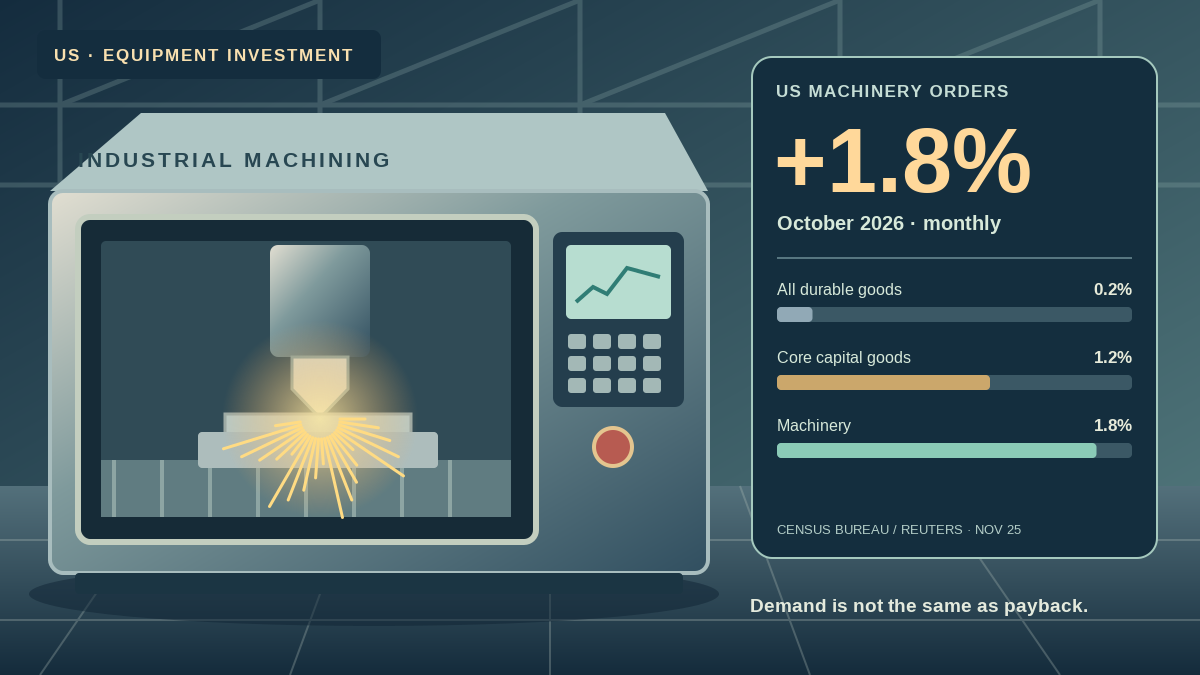
American manufacturers received more machinery orders in October, even as growth in the wider market for long-lasting goods slowed. The latest figures offer a useful snapshot of demand for industrial equipment, but they cannot establish whether a particular purchase makes financial sense for a small business.
On November 25, 2026, the US Census Bureau reported that October durable goods orders reached $346.7 billion, up 0.2% from September. Machinery orders rose 1.8% to $46.8 billion. September's overall durable goods increase was revised to 2.0%.
Three measures, three different signals
Sources: Census Bureau and Reuters, November 25. Common zero baseline and 2% scale. The categories overlap; the rates cannot be added together.
Reuters reported a 1.2% rise in non-defense capital goods orders excluding aircraft, a commonly used indicator of equipment investment demand. The increase exceeded the 0.7% consensus forecast in its economist survey.
Orders are not the same thing as completed sales or production. A factory may accept an order months before the machine is delivered. The dollar value of orders can also rise because of price changes, not necessarily because buyers ordered more units. National data should therefore be read as a broad business indicator rather than a measure of any individual company's profitability.
Is now the right time to buy equipment?
Suppose a workshop is considering a new machine to automate a recurring task. The quoted purchase price is only the beginning. Installation, electrical work, training and disruption during setup may add to the initial cost. After commissioning, the machine may reduce outsourced work or improve output, but it also needs maintenance, energy and potentially additional software subscriptions.
One straightforward screening measure is simple payback: the time needed for cumulative net operating savings to equal the upfront investment. A $48,000 installed machine with $2,000 in monthly net savings would have a simple payback period of 24 months, assuming the savings start immediately and remain constant.
Equipment investment payback calculator
Replace the fictional figures with your own estimates in US dollars.
Monthly net savings: $2,000.00. Simple payback: 24.0 months (2.00 years).
Assumes stable monthly cash benefits beginning immediately. Excludes financing, taxes, depreciation, resale value, inflation and discounting. No data is transmitted by the calculator. Results are illustrative, not an investment recommendation.
Test what happens if the machine is used less
A machine bought for an anticipated contract may be less profitable if the contract is delayed or production volumes fall. A sensitivity analysis helps identify how much the investment depends on optimistic assumptions.
| Monthly net savings | Payback on $48,000 |
|---|---|
| $1,000 | 48 months |
| $1,500 | 32 months |
| $2,000 | 24 months |
| $3,000 | 16 months |
These examples use the same initial cost and change only the monthly net benefit. They are hypothetical scenarios, not industry averages. If a machine is expected to last only three years, a four-year payback would not recover its cost through operating benefits alone during that lifespan.
Review the cash flow before signing
Ask suppliers for written quotations covering delivery, installation, warranties, spare parts and service availability. If possible, use a demonstration with your actual materials and measure throughput, waste and downtime. Count labor savings only when they reduce real cash expenses or free capacity that the business can profitably use.
If you borrow to fund the purchase, model the monthly debt payments separately. Even an asset with a short simple payback can create a cash shortage if customers pay slowly or loan payments start before installation. For larger investments, consider discounted cash flow and the value of alternative uses of the money, rather than relying on payback alone.
When the next figures arrive
The Census Bureau schedules the full October manufacturing report for December 3 and the November advance durable goods release for December 23. October's initial figures may be revised. The latest report provides evidence of machinery demand at a national level, not a guarantee that an equipment purchase will succeed in a particular business.
Sources & further reading
AI-assisted, source-based explainer, not firsthand manufacturing reporting or individual financial advice. The Census Bureau HTML release and Reuters report were reviewed directly; the detailed statistical tables were not independently analyzed. Calculator examples are original fictional scenarios. See editorial standards for corrections.