Todoist breach exposes older password hashes of about 6% of users: what to do now
Todoist updated its incident report on November 25. Understand the affected data categories and build a private account recovery checklist without entering any secrets.
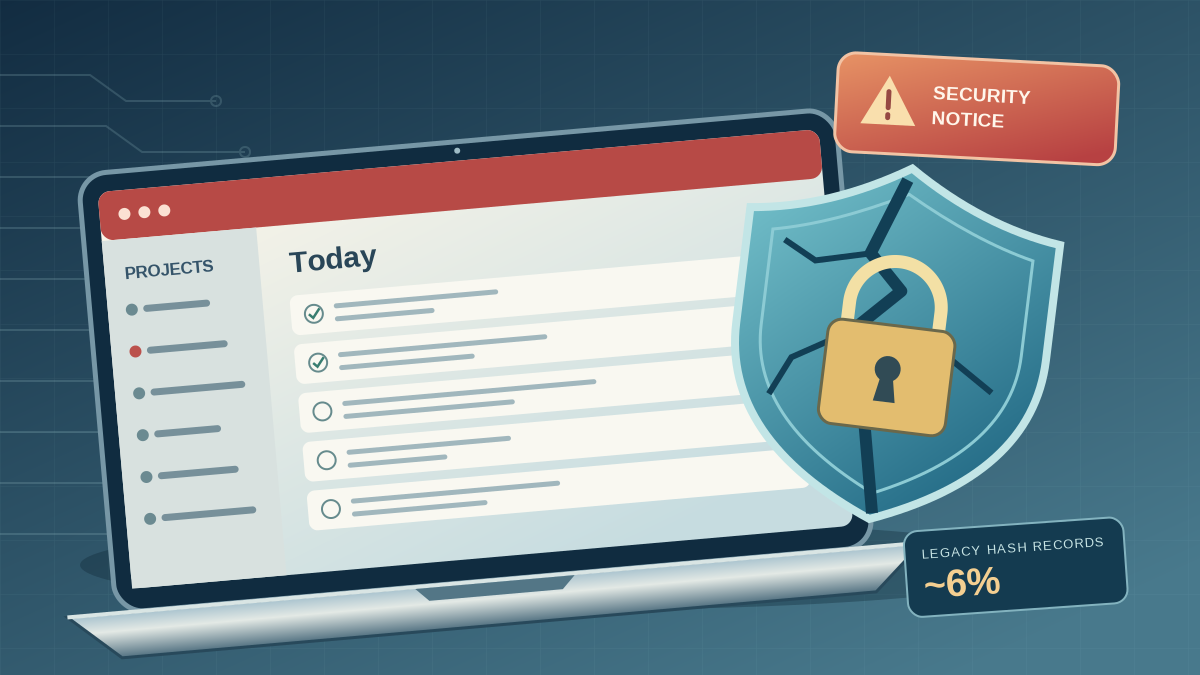
Task-management service Todoist has expanded its disclosure about a cyberattack that reached its customer systems on November 23. The company first published its notice on November 24 and updated it on November 25 with further information about affected content and connected applications. TechCrunch reported the incident on Wednesday.
According to Todoist, the largest affected group represents approximately 6% of its users. Records in that group contained email addresses, account creation dates and hashes derived from passwords stored using a legacy method. This is not the same as a confirmed leak of every user's plaintext password.
Four reported categories of exposure
Source: Todoist's November 25 incident notice. Rounded estimates; categories can overlap and should not be added to calculate a precise total.
For some accounts in the smaller groups, the incident involved access to task data or email previews. Todoist says affected customers received individualized notifications. It has disabled exposed passwords and tokens where appropriate. The company says customers without a notification need not take incident-specific action.
Why a password hash still matters
A well-designed sign-in system does not need to store a password in a form that can simply be read back. Instead, it can store a derived value and compare that value with the result of a later login attempt. Older approaches offer less protection against attempts to guess passwords than modern password storage methods.
Even if the affected application has already disabled a password, the same password could still work on an entirely unrelated service. That is why changing a reused password everywhere it was used matters more than simply regaining access to the original account.
Build your recovery checklist
Read the actual notice for your account through a trusted channel. Select the situations that apply to you. Never paste a password, token, recovery phrase, email address or notification into this tool.
Select the relevant situations to get your next steps.
This is a general planning aid, not a breach lookup or an account security assessment. Selections are processed by this page's script without transmitting them or saving them. Always follow your provider's instructions.
Do not confuse a task list with a password vault
Productivity apps make information easy to find and share. Those qualities can be useful for a deadline or a grocery list, but they can create unnecessary risk when a note contains a key that grants access to another account. Moving an exposed secret into a different app does not make the original secret safe again. Replacing it at the issuing service is the important step.
For future use, separate ordinary project documentation from credentials. A dedicated password manager can generate and retain individual login passwords; an organization's approved secrets manager can handle software credentials. Limit shared documents to the people who need them, rather than treating an unlisted URL as permanent access control.
Watch for follow-up scams
A real incident can provide criminals with a convincing excuse for sending fake security notices. Avoid signing in through unexpected links. Open the service using a bookmark or by typing its known address, and verify unusual instructions with support. Todoist says its response does not require customers to send passwords or install software.
The US Cybersecurity and Infrastructure Security Agency recommends unique, lengthy passwords, a password manager and multifactor authentication wherever supported. Review these protections before an incident rather than only after receiving a warning. For a work account, report possible exposure to the responsible security team so it can coordinate recovery.
What remains uncertain
The investigation has not established the original source of the stolen credential. The published percentages are estimates, and the notice distinguishes attempted access from data confirmed to have been retrieved. Readers should avoid treating those figures as a definitive assessment of any individual account.
Sources & further reading
AI-assisted, source-based explainer. Incident details and estimates are attributed to Todoist; we have not independently examined its systems or individual accounts. The interactive checklist does not verify exposure. See editorial standards for corrections.