GM’s California EV power-sharing pilot offers up to $16,099 in incentives: what drivers should know
Select Southern California Edison customers could receive support for bidirectional charging hardware and installation. Compare estimated costs and understand how vehicle-to-grid power differs from home backup.
For a homeowner with an electric vehicle parked in the driveway, a battery that normally powers a daily commute could also become part of the home's energy system. General Motors announced on November 19 a limited California pilot with WeaveGrid. Automotive trade publication F&I and Showroom covered the initiative on November 25, 2026.
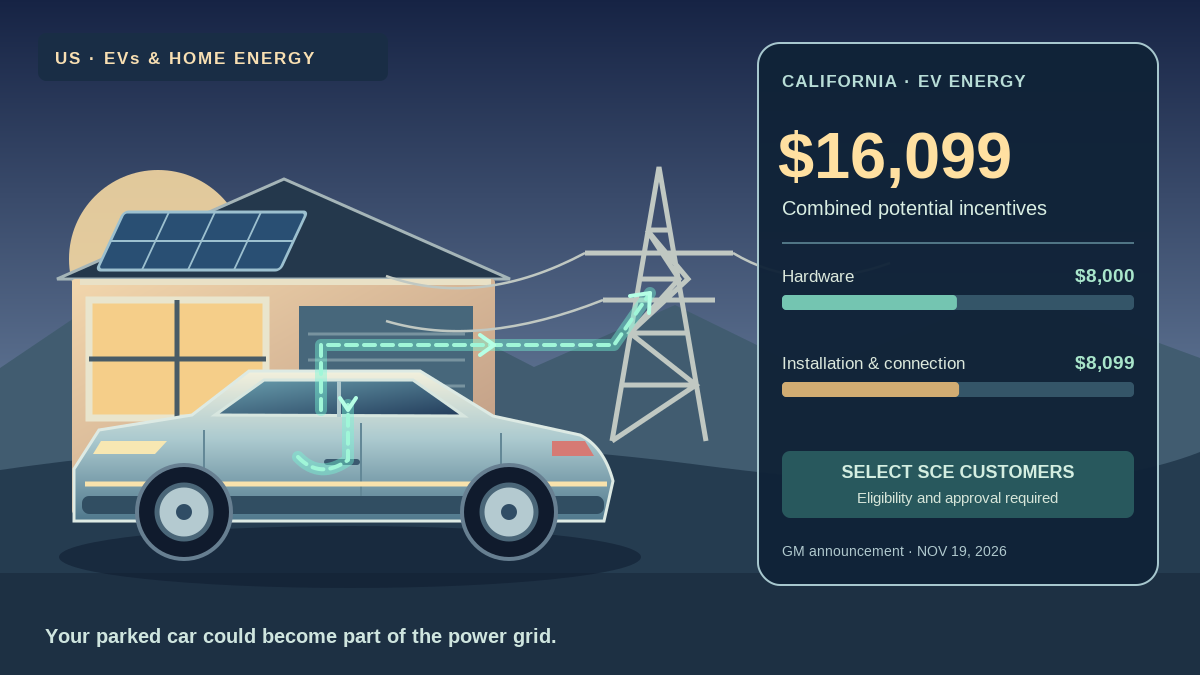
The program is aimed at selected Southern California Edison (SCE) customers participating in the utility's Emergency Load Reduction Program. Funding could cover substantial portions of qualifying equipment and installation costs, but it is not a universal EV rebate or a guaranteed payment to every driver.
What the potential incentives cover
Source: GM, November 19. The two funding ceilings apply to different categories of expenditure. The combined figure is their sum, not a separate grant. Eligibility, actual costs and program approval determine the amount available to a particular household.
Three ways a parked EV can interact with energy infrastructure
| Technology | Function |
|---|---|
| Managed charging | Moves charging to a different time; power need not flow out of the car. |
| Vehicle-to-home (V2H) | Uses the vehicle battery to supply compatible home equipment. |
| Vehicle-to-grid (V2G) | Exports power to the utility network through an approved system. |
GM says its current home system converts direct current from the battery into alternating current using an inverter. It is also pursuing AC-based systems and working with an industry standards group. The pilot will help the participants test the practical process of connecting a home to the grid, rather than simply demonstrating a laboratory power transfer.
Estimate the remaining installation cost
Enter your own quotes and expected approved incentives. The example uses fictional costs, not advertised GM prices. Each incentive is capped at its published maximum and cannot exceed the corresponding eligible cost in this illustration.
Total project cost: $20,000.00. Illustrative incentives: $16,099.00. Remaining cost: $3,901.00.
This is a budgeting illustration, not an eligibility check or funding offer. Actual reimbursable costs and payment timing depend on written program terms. Enter zero for unconfirmed incentives to see the unsubsidized cost. All calculations run locally.
What could you earn from electricity exports?
Exporting power is not free income: electricity used to recharge the battery has a cost, and conversion losses mean that the energy drawn from the grid may exceed the amount later exported. Battery wear, vehicle availability and program restrictions also matter. GM says qualifying drivers may receive compensation for eligible demand-response events, but its announcement does not establish a guaranteed annual revenue figure.
For illustration, if an approved event pays a hypothetical $1.50 for each kilowatt-hour exported and a driver exports 10 kWh, the gross payment is $15. If restoring the charge takes 12 kWh at $0.30 per kWh, the electricity cost is $3.60, leaving $11.40 before battery wear, taxes or other costs. These rates and energy quantities are invented examples, not the pilot's payment terms. Revenue also depends on how often qualifying events occur.
Questions to ask before committing
Confirm your vehicle's exact model and compatibility, whether your property can accommodate the approved equipment, and whether you are eligible for the selected pilot. Obtain an itemized written quote from a qualified installer, including any necessary electrical upgrades. Ask when funds are paid and whether an upfront payment is required.
Review the utility's export authorization requirements and applicable rate plan. A home backup capability is not automatically permission to export power. Ask how participation affects your battery warranty, minimum departure charge, ability to opt out of events and access to backup power. Do not attempt to connect an EV battery to household wiring using improvised equipment; use the approved installation and utility process.
Options outside the pilot
GM reports that its managed charging partnerships already span 13 utilities. Depending on location, those programs may offer a less equipment-intensive way to earn a credit or reduce electricity costs by moving charging to suitable hours. WeaveGrid's July announcement describes the broader partnership. Check with your own utility rather than assuming the California funding applies elsewhere.
The practical significance of this trial is that an EV may become useful even when it is not being driven. Whether that benefit justifies the expense depends on your actual approval, equipment costs and household energy needs.
Sources & further reading
AI-assisted, source-based explainer, not firsthand equipment testing or electrical advice. GM's announcement and November 25 F&I and Showroom coverage were reviewed directly, as was EV.com's November 24 report. Individual enrollment agreements, utility export rates and equipment quotes were not independently verified. Calculator and export example are illustrative. See editorial standards for corrections.