EU delays Tesla assisted-driving talks until 15 December: what it means for drivers
The rescheduled meeting leaves EU-wide authorisation unresolved. National permissions and the driver's obligation to supervise the system are separate questions.
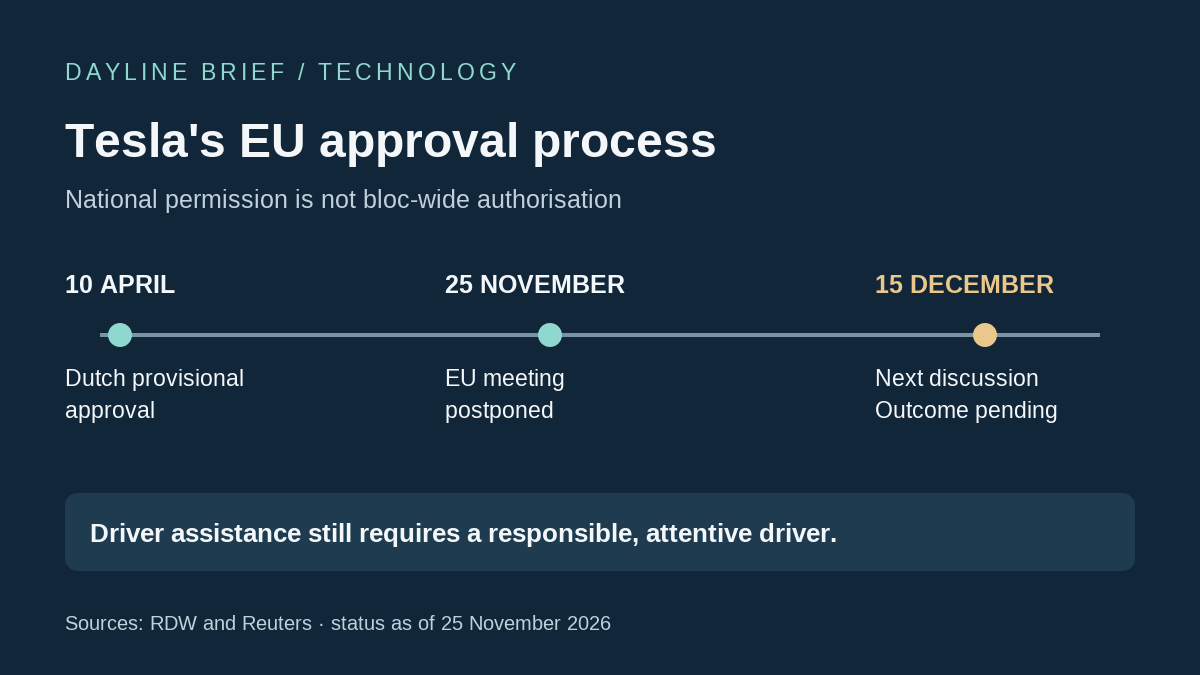
A new date, not a new permission
A European Union meeting concerning Tesla's advanced driver-assistance software has been moved to 15 December 2026, a European Commission spokesperson told Reuters on Wednesday. The change, reported on 25 November, means the company's application for authorisation across the EU is still unresolved.
There is an important difference between scheduling a discussion and adopting a decision. The new date does not establish when a vote will occur, how governments will vote or when software might become available in additional countries. A postponement is neither a rejection nor an approval.
How the Netherlands fits into the process
In April, the Dutch vehicle authority RDW granted provisional type approval for Tesla's FSD Supervised system following an assessment lasting more than 18 months. That decision initially applied in the Netherlands. RDW's published explanation describes a separate European process: the application goes to the Commission and representatives of member states vote in the responsible committee.
Italy also gave the system a green light on 20 November, according to Reuters. These developments illustrate why a national permission should not be confused with an authorisation valid throughout the bloc. A driver making a cross-border journey may encounter different conditions on either side of a national boundary.
Why supervised driving is not autonomous driving
The word “self-driving” can give a misleading impression of what a system is permitted to do. RDW explicitly classifies the Tesla feature as assistance controlled by a human driver. The system may perform several driving tasks, but the person at the controls retains responsibility and must be ready to intervene immediately. Driver monitoring does not transfer that responsibility to the vehicle.
Consider a roadworks diversion where the usual lane markings are partly obscured. A driver using assistance must still pay attention to temporary signs, traffic movements and the path ahead. The relevant question is not merely whether the software can negotiate a particular situation; it is whether the person can recognise a problem and respond safely if needed. That example is illustrative, not a claim about the system's performance in a specific test.
Three questions that matter to a buyer
| Question | What to establish |
|---|---|
| Is it authorised? | Check the country and applicable conditions. |
| Can my car use it? | Check the specific vehicle, software version and eligibility. |
| What must I do? | Follow the manual, remain attentive and retain control. |
These questions are independent. A legal clearance does not necessarily mean every existing car receives the feature on the same day. Hardware compatibility, software rollout and the terms of a purchased feature may all affect a customer's experience. Before paying for an upgrade, buyers should establish which functions are actually available on their own vehicle in the country where they intend to drive.
Why software updates are part of the story
RDW announced on 3 November that it had assessed and cleared changes to the system. This is a useful reminder that the regulatory discussion concerns a particular technology as it evolves, rather than an abstract promise that every future version will be acceptable.
For regulators, a key challenge is evaluating systems whose capabilities can change after a car is sold. For consumers, a practical challenge is distinguishing a demonstration, a future feature and a function currently supported on the road. Marketing descriptions alone cannot establish those differences.
What to watch on 15 December
The next meaningful evidence will be an official account of the committee's proceedings, including whether it has reached a decision or requires further work. If a wider authorisation is granted, its scope and conditions will matter as much as the date. Until then, drivers should rely on current national guidance and vehicle instructions rather than assume a meeting announcement changes the rules.
Sources & further reading
AI-assisted, source-based article, not firsthand reporting. Information available on 25 November 2026. See editorial standards for corrections.