England reaches 50 rural 4G mast upgrades: is it time to switch mobile networks?
New rural mobile coverage is reaching the Yorkshire Dales, Cumbria and beyond. Check predicted signal at your address and calculate the cost of switching providers.
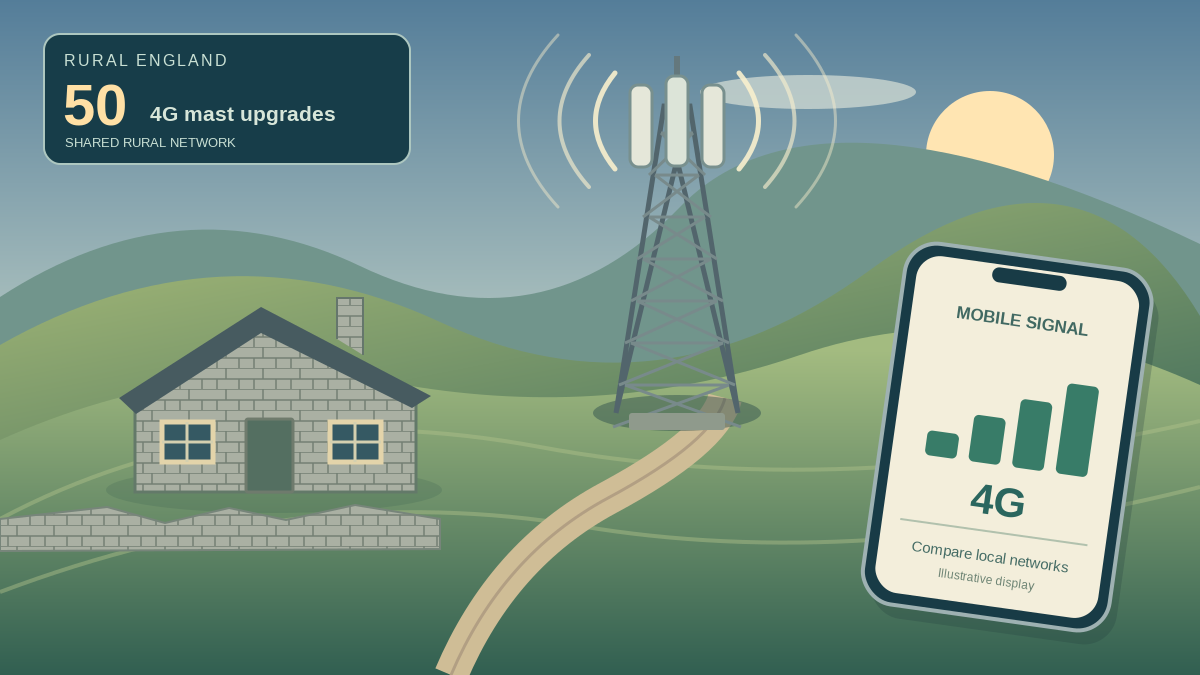
Rural mobile coverage is expanding across England as the publicly supported portion of the Shared Rural Network approaches its final delivery phase. The government announced on November 24 that 50 upgraded sites are operational, reaching approximately 640 square kilometres of additional countryside. Telecoms.com and FarmingUK reported the milestone on November 25.
For residents who previously chose a provider because it was the only one with a usable signal, the improvement is a reason to reassess the market. It is not, however, proof that every household near an upgraded site can receive a reliable indoor signal.
Where the rollout stands
Source: government announcement, November 24. Site counts and coverage area are different measures.
Yorkshire accounts for 21 upgrades and Cumbria for 12, together representing 33 of the 50 sites reported in England. The government identifies Thirsk and Malton as the location of the milestone activation. Its announcement also includes a detailed location list. Some regional subtotals differ between the official release and trade press reporting, so this article does not reproduce a complete regional breakdown.
The programme makes use of existing infrastructure, including sites intended for emergency-service connectivity. By adding commercial network equipment, operators can serve places where building a separate mast for each network would be difficult to justify.
National coverage is not the same as a signal at your front door
The government reports that at least one operator now provides 4G across more than 96% of UK land area. That measure does not mean every operator covers 96%, or that every building has service indoors. A stone farmhouse, a valley or an insulated modern house can present very different radio conditions from an open hillside.
Ofcom's Map Your Mobile service compares networks using address-level signal predictions and local performance information. Look up the places where you actually use your phone, such as home, work and regular destinations. Compare indoor and outdoor predictions separately. A predicted strong signal is not a guaranteed download speed or a real-time outage report.
Calculator: would switching save money?
Once you have identified another network that meets your coverage needs, compare its full cost with your current plan. The starting figures are hypothetical, not live tariffs.
Cost of staying: £288.00
Cost of switching: £235.00
Estimated saving: £53.00
Break-even: 7 months of billing
Assumes constant monthly prices and immediate switching. Use comparable plans, account for any handset payments that remain due under either option, and avoid counting shared costs twice. Does not model price increases, promotional expiry or service quality. Inputs are processed locally by this page's script.
Why the cheapest monthly price may not win
In the example, a £15 monthly plan saves £9 compared with a £24 plan. Over one year that is £108 before switching expenses. After £55 of one-off costs, the saving is £53. The initial expense takes slightly more than six months of savings to recover, so the first whole billing month at or beyond break-even is month seven.
Check whether an advertised discount expires before the end of the contract, whether scheduled price rises apply, and whether a cheaper plan includes the calls, data and roaming you require. If a handset loan continues after changing the airtime provider, incorporate its payments consistently in the comparison.
Test the network before committing
Where practical, use a low-commitment SIM or eSIM to test the underlying network on your own compatible device. Try indoor calls, ordinary web browsing and the applications that matter to you. Repeat the test at different times of day, since congestion can change performance. Different retail brands may use the same underlying mobile network, so changing brands is not necessarily a change in coverage.
For rural walks, download maps beforehand and carry suitable navigation equipment rather than relying on a continuous connection. The rollout can make remote work and travel easier, but geographic coverage statistics cannot guarantee emergency communication at a particular spot.
What comes next?
The main Shared Rural Network delivery phase is scheduled to run until January 2027. The government expects further publicly funded upgrades across Britain before that point. These are planned activations, not evidence that any specific location is already connected. Recheck local predictions and the provider's own service information before making a long-term commitment.
Sources & further reading
AI-assisted, source-based explainer. The rollout was announced November 24; this article follows November 25 coverage. No signal measurements, individual addresses, contract terms or live tariffs were independently tested. The calculator uses illustrative costs. See editorial standards for corrections.