Fake mobile phone deals surge 85% in the UK: how to check an upgrade offer before you pay
The Home Office has issued a fresh warning ahead of Black Friday. Learn how to verify a handset deal, report suspicious calls and respond if you have already shared payment details.
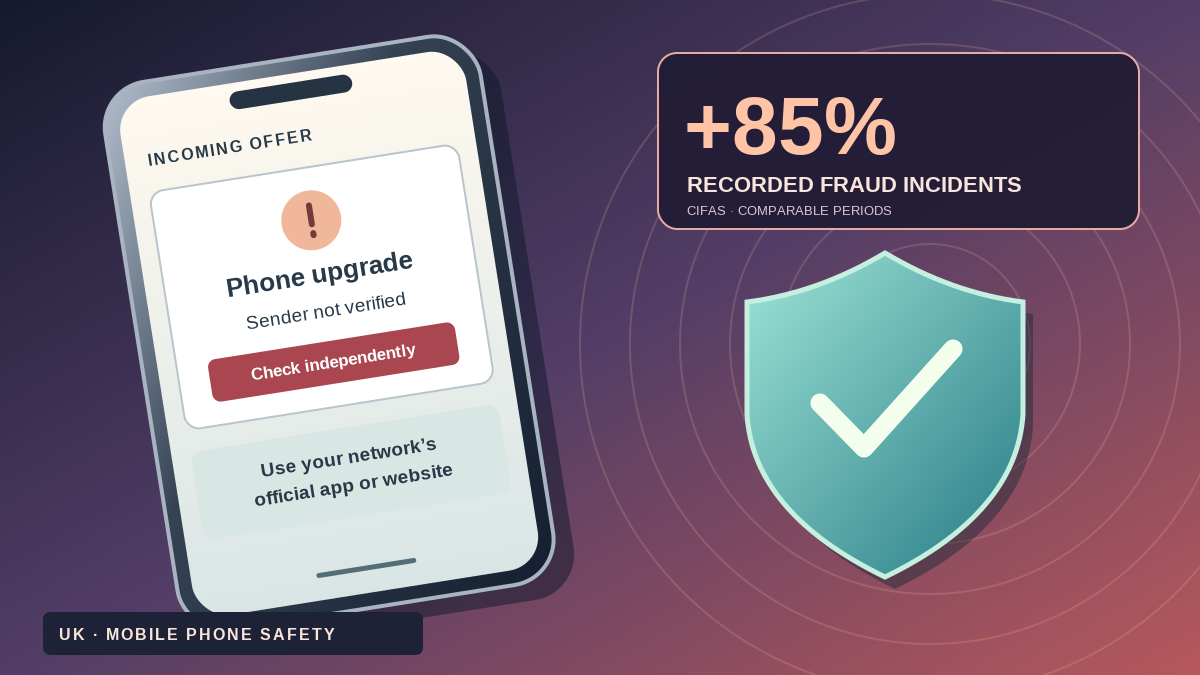
With Black Friday two days away, a cheap handset upgrade might seem like an attractive offer. But a call that appears to come from your existing mobile network is not enough to establish that the deal is genuine.
On 25 November 2026, the Home Office announced a renewed consumer awareness campaign alongside telecoms companies. It reported that coordinated action had intercepted more than one billion fraudulent calls and messages in the past year. These are blocked communications, not a count of individual victims.
The increase behind the warning
Fraud prevention organisation Cifas reported on 18 November that mobile operators had logged over 15,000 mobile dealer fraud incidents by 16 September, 85% more than in the equivalent period of 2025. The Home Office's announcement puts estimated losses above £32 million.
Derived index based on Cifas's reported 85% increase. Bars share a zero baseline. These are relative levels, not case counts or estimates of an individual's risk.
Why an incoming call is not proof of identity
The safest approach is to separate the offer from the person presenting it. A caller might know your existing network or some account details, but possessing that information does not prove that they work for the company. A familiar number on your screen does not provide reliable authentication either.
Instead, open the mobile company's app yourself or navigate independently to its official website. Ask whether the promotion is available to your account. If the offer can only be accepted through an unsolicited caller, do not proceed until you have verified it through a trusted channel.
Compare the deal itself, once you have verified it
A legitimate upgrade can still be expensive. Compare the total contractual cost rather than focusing on the advertised monthly price. Check the upfront charge, the contract duration, the allowance, the terms for any planned price increases and the balance owed on an existing device. Ask whether the handset and airtime are billed under separate agreements.
For example, a hypothetical £30 monthly plan lasting 24 months with a £120 upfront charge costs £840 before any later increases or extras. A £35 monthly plan over the same period without an upfront charge also costs £840. Neither example establishes that the two offers provide equivalent benefits.
Choose the right response to a suspicious offer
End the conversation. Verify the offer separately with your provider and report the number to 7726.
This tool provides general guidance only. It does not inspect messages, identify callers, submit reports or collect your information.
Ofcom explains that 7726 is a free reporting route supported by most UK mobile providers. App-based messages may require the app's own reporting function instead. If an incident has already occurred, preserve relevant evidence safely without interacting further with the sender. Report suspected fraud through the official service, or to Police Scotland on 101 if you live in Scotland. In immediate danger, call 999.
Can a bank recover money sent to a scammer?
Contact your bank promptly using its official app or the number printed on your card. Where the UK authorised push payment reimbursement scheme applies, qualifying Faster Payments claims have a maximum mandatory reimbursement limit of £85,000. Coverage depends on the circumstances and payment method. This is not a universal refund guarantee for every purchase, card payment or international transfer.
The most useful habit is to verify an unexpected offer independently before accepting it. A real saving will not justify exposing your entire account to an unverified caller.
Sources & further reading
- Home Office — telecommunications fraud announcement, 25 November 2026
- Cifas — mobile dealer fraud data, 18 November
- Ofcom — reporting scam calls, texts and messages
- Ofcom — protecting yourself against scams
- Payment Systems Regulator — bank transfer fraud reimbursement
- PSR — reimbursement limit
- Report Fraud — official reporting service
AI-assisted, source-based explainer, not firsthand reporting or individual legal or financial advice. The Home Office release and Ofcom response guidance were read directly. Cifas figures and PSR rules were checked against retrieved extracts. The chart, examples and decision tool are original explanatory material. See editorial standards for corrections.