Canada heads to CPTPP trade talks in Vietnam: how much could preferential tariffs save exporters?
Canada's trade minister will attend the Hanoi commission meeting on November 26–27. Learn how to assess preferential duties and compare the landed costs of a shipment.
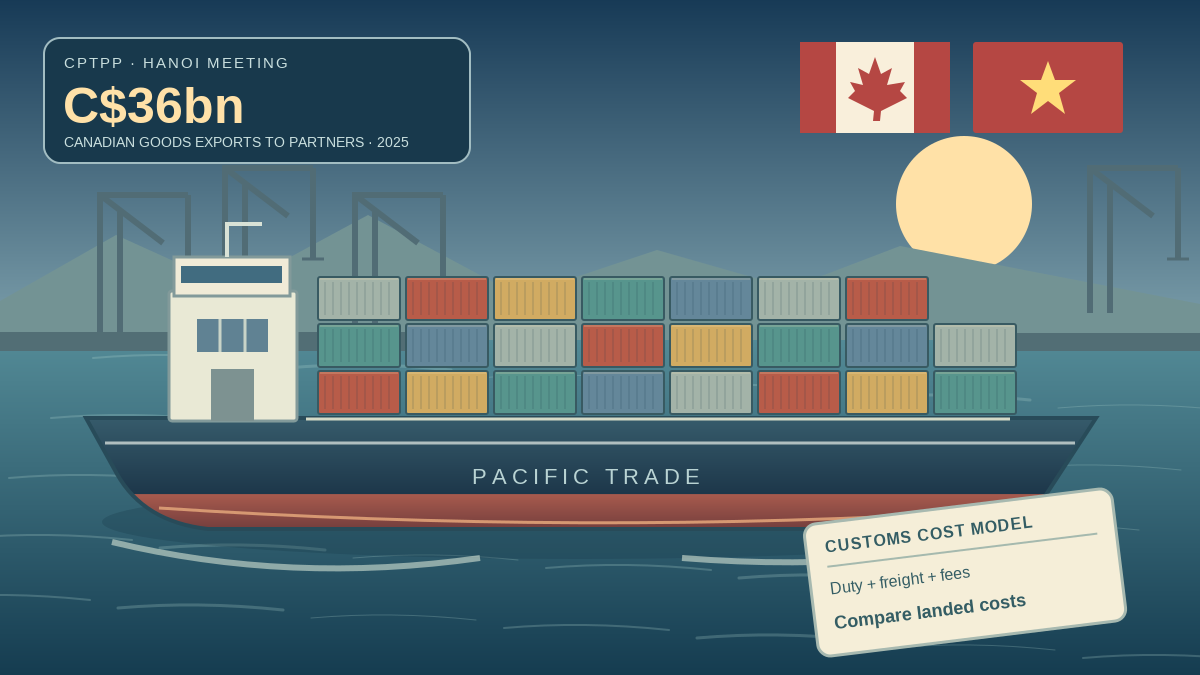
Canada is seeking to deepen its Pacific trading relationships as International Trade Minister Maninder Sidhu prepares to attend the CPTPP Commission in Hanoi on November 26 and 27. Global Affairs Canada announced the visit on November 25. Talks are expected to address cooperation, the agreement's future development and opportunities for Canadian businesses operating in Vietnam.
The government says Canadian goods exports to CPTPP partners reached C$36 billion in 2025, more than 17% above their 2021 level. The figures cover the trading group, not Vietnam alone. This week's meeting is not itself an announcement of new tariff reductions.
What the agreement means for a shipment
The Comprehensive and Progressive Agreement for Trans-Pacific Partnership (CPTPP) offers preferential market access for eligible goods. But a product exported from Canada is not automatically a product of Canadian or CPTPP origin for customs purposes. Rules differ by tariff classification and can depend on where materials were sourced and how a product was manufactured.
For an importer claiming preferential treatment, the Canadian government's guidance explains that the CPTPP requires certification that the goods satisfy origin requirements. The agreement allows the certification to be provided without a mandatory standard form, provided the required information is present. It is not enough to write the exporting country's name on a shipping label.
Calculate the financial effect of a preferential duty rate
Enter the ordinary and preferential percentage duties confirmed for your specific goods, importing market and shipment date. The initial numbers are hypothetical, not current Vietnamese tariffs. Use the same currency and valuation assumptions for both alternatives.
Ordinary customs duty: C$2,000.00
Preferential customs duty: C$400.00
Gross duty saving: C$1,600.00
Net saving after extra compliance cost: C$1,450.00
Ordinary pre-tax landed cost: C$24,000.00
Preferential pre-tax landed cost: C$22,550.00
Preferential pre-tax cost per unit: C$22.55
Simplified ad valorem model. Excludes import VAT, excise, specific or compound duties, quotas, anti-dumping charges, exchange-rate movements and other taxes. Customs value must be established under the importing country's rules; do not assume invoice value alone is sufficient. Inputs stay within the page's calculation script.
Why the paperwork cost matters
In the example, a shipment with a customs value of C$20,000 incurs C$2,000 of duty at a 10% rate and C$400 at a 2% rate. The difference is C$1,600. After an assumed C$150 additional documentation cost, the benefit falls to C$1,450, or C$1.45 across each of 1,000 saleable units.
For a much smaller shipment with a customs value of C$1,000, the same eight-percentage-point difference would save just C$80 before compliance costs. That would not cover the same C$150 expense. In practice, some documentation costs can be spread over multiple shipments, but an exporter must still maintain reliable evidence of origin.
Four steps before quoting a foreign buyer
- Classify the goods. Identify the correct tariff code and check the importing market's schedule using the official resources linked below.
- Establish origin. Obtain supplier declarations and production records where required. Compare these with the relevant product-specific origin rule.
- Allocate the costs. Agree who pays freight, insurance, customs duties and other expenses under the sale contract. A saving on the importer's duty does not necessarily become the exporter's profit.
- Check other requirements. Product permits, labelling, safety standards and import taxes can apply even where the customs duty is zero.
What to watch after the Hanoi meeting
The minister also plans to meet businesses in Vietnam and engage in dialogues with European Union and Southeast Asian partners. Canada has recently concluded negotiations on additional trade agreements with ASEAN and the Philippines, according to today's release. Negotiating an agreement is different from bringing it into force: businesses should wait for official effective dates before incorporating prospective tariff preferences into firm quotes.
Canadian exporters can use the Trade Commissioner Service's country and sector resources to evaluate a potential market. A lower tariff is only one part of a viable export strategy. Distribution costs, local demand, payment risk and the ability to comply with import requirements still determine whether a shipment makes commercial sense.
Sources & further reading
- Global Affairs Canada — November 25 announcement
- Global Affairs Canada — claiming preferential tariff treatment
- Trade Commissioner Service — CPTPP business resources and tariff finder
- Trade Commissioner Service — export operations and customs
- Trade Commissioner Service — Canadian ginseng exporter case study
AI-assisted, source-based explainer. The meeting is scheduled, not completed. No particular goods classification, current tariff rate, shipment or origin certificate was independently verified. The calculator is educational, not customs or tax advice. See editorial standards for corrections.