Social Security is renaming its retirement ages: compare your checks at 62, 67 and 70
The Claiming Age Clarity Act changes the language used to describe retirement benefits, not the benefit formula. Compare monthly checks and cumulative payments using a retirement calculator.
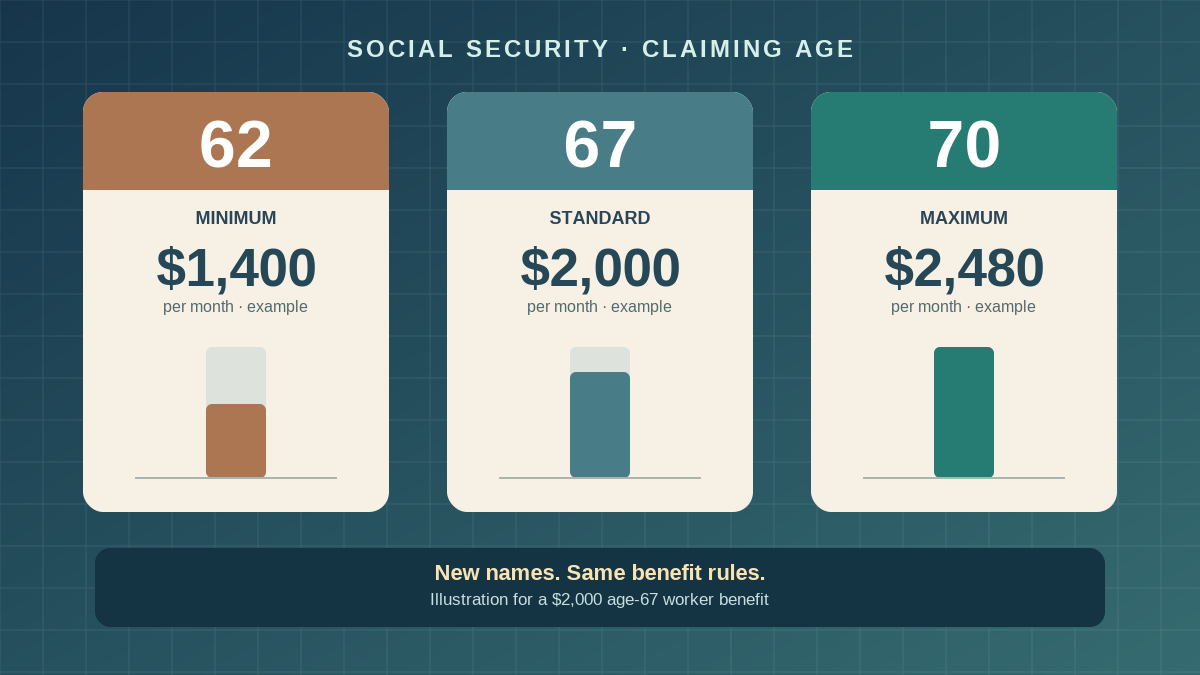
Americans approaching retirement will encounter new wording when researching when to start Social Security payments. President Trump signed the bipartisan Claiming Age Clarity Act (H.R. 5284) on November 20. The House Ways and Means Committee confirmed the change on November 23, and coverage in Kiplinger on November 24 emphasized that it does not alter payment formulas or eligibility.
The goal is to help workers understand the trade-off between receiving smaller checks sooner and larger checks later. It is not an increase in everyone's benefits, nor a change in the age at which a person must stop working.
What the new terminology means
| Age | Previous wording | New wording |
|---|---|---|
| 62 | Early eligibility age | Minimum monthly benefit age |
| 66–67* | Full or normal retirement age | Standard monthly benefit age |
| 70 | Maximum age for delayed retirement credits | Maximum monthly benefit age |
*For the birth cohorts currently approaching retirement, the standard age depends on birth year. For people born in 1960 or later, it is 67. Sources: Ways and Means Committee and SSA.
A person born in 1960 or later who qualifies for a $2,000 monthly worker benefit at age 67 would, under the existing age adjustments, receive approximately $1,400 at 62 or $2,480 at 70. These figures hold the underlying benefit constant. Actual estimates can differ if a worker continues earning, or because of benefit recalculation and other rules.
Interactive: compare your retirement payment scenarios
Enter an estimated age-67 worker benefit and a comparison age. The model applies the SSA's published factors for people born in 1960 or later. It calculates simple cumulative payments through the selected birthday, assuming payment starts at the selected claiming age and continues without interruption. Use the official SSA estimate for your own record rather than the fictional default.
Illustration only: no cost-of-living increases, taxes, earnings-test withholding, discounting, Medicare deductions, household benefits or changes to future law. It is not an official benefit estimate or personalized recommendation.
Why the largest monthly benefit is not always the largest lifetime total
In the $2,000 example, starting at age 62 produces $134,400 in payments before the age-70 claimant receives a first check. After 70, the later claimant receives $1,080 more each month. It takes roughly 124.4 months for that difference to offset the earlier payments. In this simplified example, the two totals cross around age 80 years and four months, or the next monthly payment in practice.
By age 85, the three options produce approximately $386,400, $432,000 and $446,400 respectively. At age 75, the order is different: the earlier option has accumulated more than either alternative. This is why a monthly check comparison alone cannot determine the best choice.
What to consider before choosing a date
- Cash flow: Can savings or other income cover necessary expenses while you wait?
- Work: Continuing to earn wages can affect benefit estimates and, before the standard age, payments under the earnings test.
- Household needs: Spousal and survivor benefits involve separate rules, so compare the household rather than just one check.
- Health coverage: Medicare enrollment is a separate decision; do not assume delaying Social Security means delaying Medicare is appropriate.
- Uncertainty: Future expenses, longevity and policy changes cannot be predicted by a simple calculator.
The University of Southern California's Schaeffer Center reported on November 24 that its research helped inform the new wording. Clearer labels may make comparisons easier, but they do not resolve the personal financial constraints behind a claiming decision. Workers can review their own estimates at my Social Security and ask SSA or an appropriately qualified adviser about their situation.
Sources & further reading
- House Ways and Means Committee — November 23 announcement and terminology
- Senator Tim Kaine — bipartisan legislation
- Kiplinger — November 24 coverage of the law
- Social Security Administration — existing age adjustment factors
- SSA — delayed retirement for people born in 1960 or later
- USC Schaeffer — research informing the new terminology
AI-assisted, source-based explainer. Published November 25, 2026; the law was signed November 20. Figures are simplified illustrations and not individualized financial advice. See editorial standards for corrections.