Why AI subscribers keep switching: calculate whether your chatbot subscription is worth paying for
New coverage of US consumer payment research highlights low long-term retention across paid AI services. Compare annual subscription costs and the value of time saved.
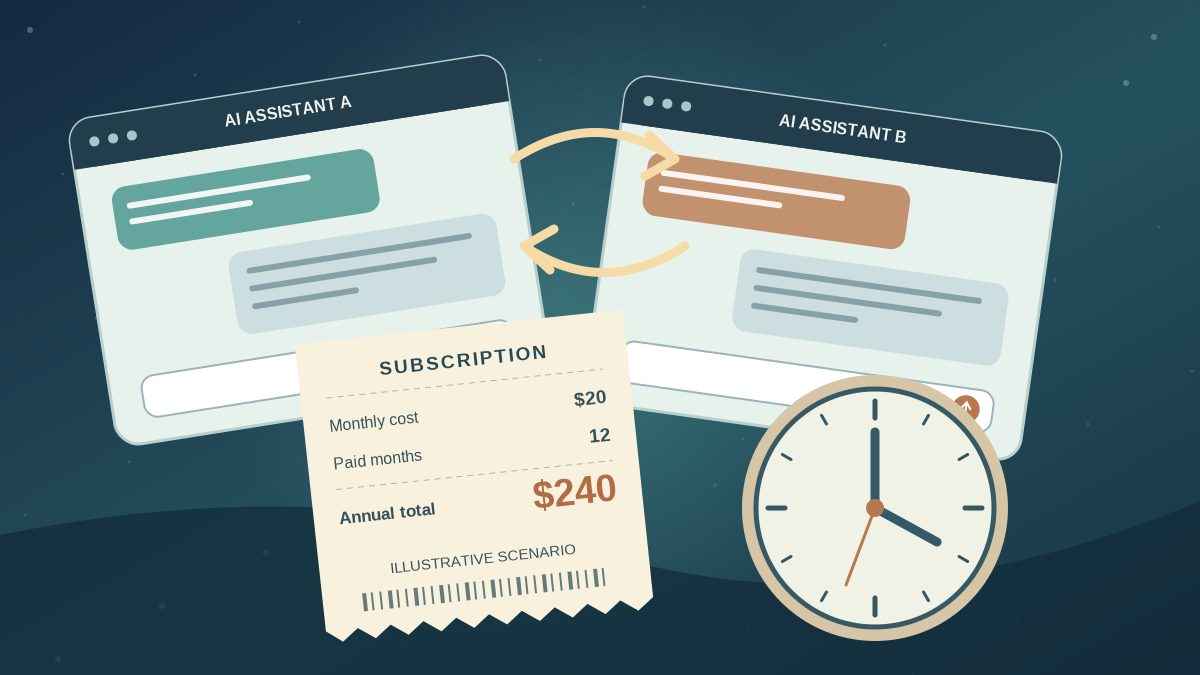
Paying for an AI assistant is increasingly a regular household expense, but keeping the same subscription for an entire year is far from inevitable. Quartz revisited research into consumer AI subscription loyalty on November 25, focusing on the implications of competition for providers' pricing power. The underlying research was released in October, not today.
The National Bureau of Economic Research (NBER) working paper, Competition in Generative AI: Evidence from Consumer Demand, by Mark Egan, Dominic Russel, Claire Shi and Vincent Yao, draws on credit and debit card transaction data. Its abstract reports one-year retention ranging from 20% to 45% among leading paid AI services. The researchers' broader transaction dataset encompasses 174 million consumers and 114 billion payments; these figures are not the number of paying AI customers in the study.
What subscription retention tells us
Imagine 100 people starting a paid subscription. If 35 are still counted as customers a year later, the cohort's twelve-month retention is 35%. This does not mean the company's overall customer base shrank by 65%. New subscriptions can more than offset customers who leave. Nor does it establish that those who stop paying have abandoned AI: some may use free services, switch providers or return later.
Transaction records can reveal purchasing patterns but cannot directly measure the quality of every answer, the value people get from free tiers or whether a subscription is reimbursed by an employer. The NBER publication is a working paper rather than a final peer-reviewed journal article. Its historical estimates should not be treated as live cancellation statistics for individual providers.
Why two subscriptions can be harder to justify than one
Many AI tools compete across overlapping jobs, including drafting, coding and summarizing. Paying for a second assistant may provide a genuinely useful alternative when the first cannot complete a task. It may also duplicate access to capabilities you rarely use. The right comparison is the extra benefit you receive from the second subscription, not everything you accomplish with both tools combined.
Research from YipitData provides another view. Its August analysis of a US consumer panel followed people with a paid ChatGPT signal in December 2025. Six months later, retention was 72.5% for those who had also paid for Claude, versus 80.4% for those who had not. This is an observed difference between groups, not proof that buying another subscription causes cancellation. Different starting dates and retention definitions also mean these figures cannot be directly compared with the NBER annual estimates.
Interactive: audit the value of a paid AI subscription
Use this calculator for one plan at a time. If a free alternative performs some tasks equally well, enter only the additional time saved by the paid plan. Include time spent checking answers and correcting mistakes. For a second subscription, enter the benefit beyond your first subscription.
Default inputs are fictional, not the advertised price of any particular AI product.
Time value is subjective; it is not automatically income or cash savings. The tool assumes constant prices and usage during paid months, ignores annual-plan discounts and excludes any value unrelated to time.
A worked example: keeping a $20 monthly plan
Paying $20 each month costs $240 over a full year. Suppose the plan saves an additional ten minutes on 20 tasks every month. That amounts to 40 hours per year. Assigning a personal value of $15 per hour gives an illustrative benefit of $600, or $360 more than the subscription fee. The break-even point in this scenario is eight tasks per month.
If the same tasks can be performed just as efficiently using a free plan, the additional time benefit is zero. If you only need premium access for six months and can cancel without further charges, your hypothetical cost falls to $120. An annual contract or a nonrefundable upfront payment may not offer that flexibility.
How to run a practical subscription review
- Check the actual charge, billing frequency and renewal date in the account that manages your payment.
- Keep a one-week record of tasks for which premium features were genuinely necessary. Include failed attempts and time spent verifying outputs.
- Compare the same tasks with suitable free or existing tools, using non-sensitive test inputs.
- Review limits, file support, data controls and any other capabilities that matter independently of time saved.
- Before canceling, confirm whether access ends immediately or at the end of the paid period, and whether you need to export your own work.
Low customer retention is not itself evidence that a particular subscription is bad value. A person who relies on a paid tool daily may have good reason to keep it. Someone who subscribes for an occasional project may prefer a shorter commitment. Research on customer behavior helps explain the market, but an individual decision is best grounded in actual use.
Sources & further reading
AI-assisted, source-based explainer. Published November 25, 2026. The underlying studies predate today's coverage; no live subscriber totals or provider pricing were independently measured. The calculator is illustrative, not a guarantee of financial return. See editorial standards for corrections.