New York bans AI companion toys for five years: what parents should know before Christmas
A law signed November 24 pauses sales of covered AI chatbot toys starting in February 2027. Here is how to distinguish them from ordinary electronic toys and review privacy risks before buying.
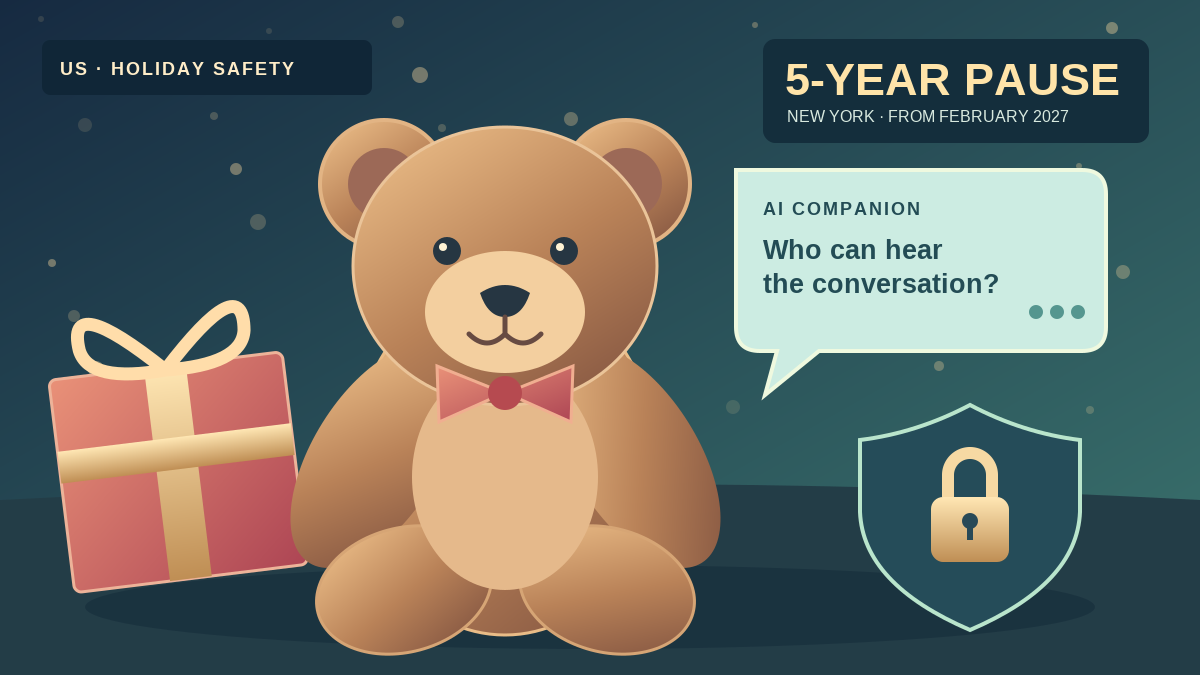
A stuffed animal that invents stories and remembers a child's favorite things may look like an ordinary gift. But the software behind that interaction is now the subject of a significant new law in New York.
Governor Kathy Hochul signed the measure on November 24, 2026, at a toy shop in Harlem. ABC7 New York reported the following morning on the governor's concerns about children's exposure to inappropriate conversations and inadequate safeguards. The legislative record identifies the signed measure as Chapter 416.
When will the new restrictions start?
The restriction covers manufacture, commercial supply and sale of covered chatbot toys in New York. The attorney general can seek injunctions and civil penalties of up to $15,000 per violation per day. The measure does not take effect during the current holiday shopping season. Its text does not establish a blanket prohibition on a family's possession of toys already purchased.
Not every electronic toy is an AI companion
The legislation uses New York's existing statutory definition of an AI companion and the federal definition of a children's toy, which covers products intended for play by children aged 12 or younger. Features that create a continuing simulated relationship are particularly relevant. The legal classification depends on the actual design, not the use of the letters AI on the packaging.
| Illustrative toy | Feature to examine |
|---|---|
| Traditional plush bear | No connected software. |
| Electronic toy with recorded songs | Predetermined sounds rather than open-ended conversation. |
| Programmable robot | Check whether it includes companion software, connectivity or data collection. |
| Conversational companion doll | May maintain personalized dialogue and remember previous interactions. |
Fictional examples, not legal determinations or product endorsements.
Why parents should look beyond the age label
Consumer advocates have reported instances of AI toys producing unsuitable responses during extended conversations. A product that behaves appropriately in a brief demonstration may respond differently later. The American Psychological Association has also highlighted the limited evidence about developmental effects of generative AI toys in early childhood. That uncertainty matters when a product is marketed as an educational companion.
The Toy Association acknowledged the new measure and described its work on safety guidance for the industry. Product designers and policymakers face the challenge of distinguishing useful interactive learning features from systems that encourage ongoing personal attachment.
Before buying a connected toy
Holiday toy privacy checklist
Review these points yourself before deciding whether to buy or activate a connected device.
0 of 5 questions reviewed.
For adult shoppers. This tool does not certify toy safety or collect information about children. The checklist runs locally in your browser.
What federal privacy protections already exist?
Under the federal Children's Online Privacy Protection Act framework, covered online services collecting children's personal data generally need to notify parents and obtain verifiable parental permission, subject to limited exceptions. Parents have rights to review and request deletion of covered information. The FTC's rules also extend to relevant internet-connected toys.
If you already own a connected toy and cannot establish what its software does, consider disabling the networked companion features until you understand its privacy and safety settings. Follow the manufacturer's instructions rather than attempting unsafe modifications to the toy's hardware. For a simpler gift, ordinary books, puzzles, building sets and unconnected toys avoid the particular risk of remote chatbot conversations, although ordinary product safety and age suitability still matter.
New York's restriction is state-specific, not a federal nationwide ban. Its significance this holiday season is the reminder that the software in a toy deserves as much scrutiny as its physical components.
Sources & further reading
- New York State Senate — S9408A, final text
- New York State Legislature — legislative history and signature, November 24, 2026
- ABC7 New York — report from Harlem, November 25
- The Guardian — coverage, November 25
- American Psychological Association — research on AI toys and early development
- FTC — questions to ask about connected toys
- FTC — children's online privacy rules
- The Toy Association — industry response
AI-assisted, source-based reporting, not firsthand reporting, product testing or legal advice. The legislative text, signature record, ABC7 report and FTC consumer guidance were reviewed directly; the research and industry commentary were checked through retrieved extracts. The effective date is calculated from the signed law's 90-day provision. The examples are fictional. See editorial standards for corrections.