NASA's Europa Clipper will swing past Earth on December 3: find your local flyby time
NASA's Jupiter-bound spacecraft is preparing for an Earth gravity assist. Explore the mission timeline, convert the predicted flyby time and follow the spacecraft online.
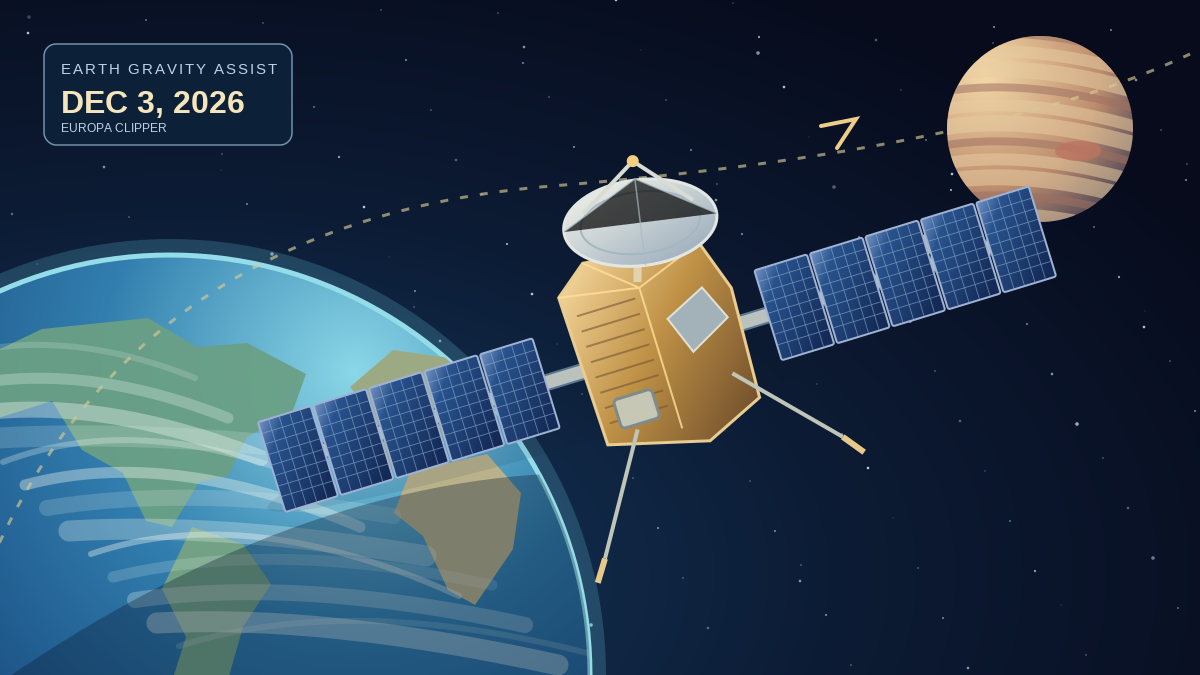
NASA's Europa Clipper is returning to Earth's vicinity for a brief encounter before continuing towards Jupiter. In an update published November 25, the Jet Propulsion Laboratory (JPL) set the predicted closest approach for Thursday, December 3, at 3:14 p.m. Eastern Standard Time. The spacecraft will pass west of Africa, roughly 2,000 miles (3,200 kilometres) above Earth.
The encounter is part of a planned route to Jupiter's moon Europa, not a return to Earth's orbit. NASA says the spacecraft will gain speed and change direction while its scientific instruments gather measurements that will help prepare them for work at Jupiter.
When is the flyby where you live?
The moment of closest approach is one predicted event worldwide. Australia and New Zealand will already be on December 4. Use the selector to convert NASA's published estimate to a local time.
Thursday, 3 December, 20:14 UTC
Conversion of NASA's November 25 prediction (20:14 UTC). This is not live tracking or a guarantee of visibility. Times may be revised by the mission team. Your device's time zone is used locally; no location permission is requested.
How to follow the encounter
JPL says observers with suitably large amateur telescopes in parts of southern Europe and Africa may be able to see the spacecraft. Exact visibility depends on location, the spacecraft's brightness, the weather and the local horizon. Do not assume that a close approach at a given time means it will be visible from your home.
For everyone else, the easiest way to explore the flyby is through NASA's Earth flyby participation page, which links to its Eyes on the Solar System simulation. The simulation lets readers follow the spacecraft's path without having to locate it through a telescope. It is a modeled view, not a live camera feed. NASA also provides background videos and educational material.
Why fly back towards Earth instead of heading straight to Jupiter?
Spacecraft travel around the Sun, just as the planets do. Reaching another planet requires more than pointing in its direction: the trajectory must intersect the destination at the right time, with a speed and direction that allow the spacecraft to arrive safely.
A gravity assist uses the motion of a planet to change a spacecraft's orbit around the Sun. In an idealized two-body encounter, the spacecraft leaves the planet with approximately the same speed relative to the planet as when it approached, but with its direction changed. Measured relative to the Sun, that change in direction can translate into an increase or decrease in speed. The geometry of the encounter determines the result.
Using this technique allows mission planners to trade travel time and carefully arranged planetary encounters for a reduction in the propellant needed to reshape an orbit. The December encounter follows a flyby of Mars in March 2025.
Europa Clipper's journey at a glance
- 14 Oct 2024Launch from Florida
- 1 Mar 2025Mars gravity assist
- 3 Dec 2026Planned Earth gravity assist
- Apr 2030Planned Jupiter orbit insertion
- Spring 2031First planned Europa flyby
- May 2031First main science campaign
Source: NASA mission timeline. Future milestones are planned, not guaranteed. Diagram is chronological; spacing is not proportional to elapsed time.
Earth is a useful test target
JPL plans to operate all nine scientific instruments during the encounter. The spacecraft's magnetic-field instrument can be checked against the well-studied magnetic environment of Earth. Its infrared imaging system will collect thermal observations, and its ultraviolet instrument will study the outer atmosphere.
Calibration matters because researchers must distinguish a genuine feature of Europa from an instrument offset or interference produced by the spacecraft itself. Earth offers a reference that is far better understood than an icy moon hundreds of millions of miles away.
What scientists hope to learn about Europa
Europa's surface is covered in ice. Observations from earlier missions support the possibility of a substantial ocean beneath that exterior. Liquid water is one ingredient associated with life as we know it, but water alone does not establish that life exists.
Europa Clipper is a habitability mission: it will investigate whether the moon offers conditions that could support life. It is not designed to land on the surface, drill into the ocean or directly confirm the presence of organisms. NASA's mission timeline describes repeated close encounters, some potentially as low as 25 kilometres above Europa, while the spacecraft follows an orbit around Jupiter.
The December flyby will not answer those questions. Its value is helping the spacecraft reach the right place, with a scientific payload ready to make sense of the observations it collects there.
Sources & further reading
AI-assisted, source-based explainer. The predicted closest-approach time comes from NASA's November 25 update, not an independently calculated ephemeris. Local times were calculated from that prediction; no observational visibility or live stream was verified. See editorial standards for corrections.