NASA’s next ISS cargo flight carries 11,000 pounds: what’s aboard and when to watch
The Cygnus XL mission is targeting November 29 with experiments on muscle loss, plant growth and space technology. Find the scheduled launch time in your time zone.
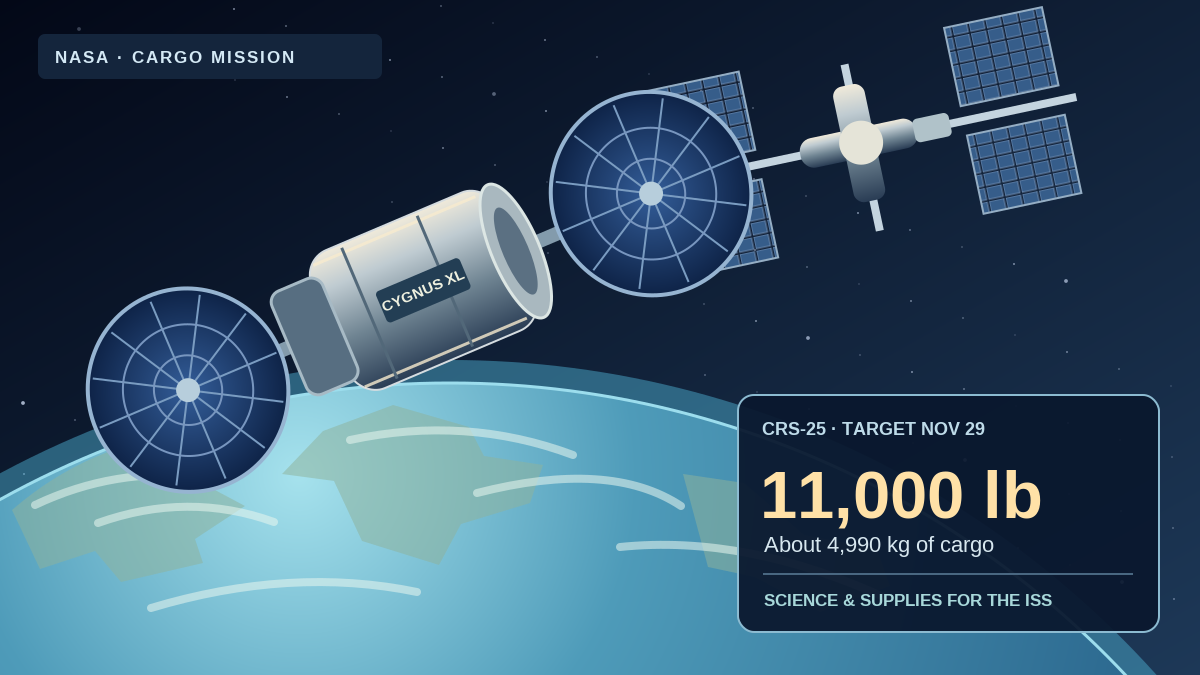
A spacecraft the size of a delivery vehicle is preparing to bring a much larger scientific agenda to orbit. NASA's November 24 mission overview describes the research and supplies assigned to Northrop Grumman's upcoming CRS-25 flight to the International Space Station (ISS).
The planned cargo weighs approximately 11,000 pounds, equivalent to about 4,990 kilograms. A Falcon 9 will launch the Cygnus XL from Florida. It will be the third flight of the enlarged Cygnus design. The current target is Sunday, November 29, 2026, at 10:47 a.m. Eastern Standard Time, rather than a confirmed liftoff.
When and where to watch
NASA plans to start its live launch broadcast at 10:25 a.m. EST. Its schedule also targets December 1 for the spacecraft's capture at the station. The launch and arrival times are provisional; weather, vehicle checks and orbital operations may cause changes.
Launch coverage starts: Sun, Nov 29, 10:25 AM EST
Target liftoff: Sun, Nov 29, 10:47 AM EST
Target capture: Tue, Dec 1, 2:35 AM EST
Watch through NASA Live · Check the latest mission schedule
Converts the schedule announced by NASA, not a real-time launch tracker. Dates can change across time zones. Recheck the official event page before making plans. The tool runs in your browser.
Five experiments and a technology test
The payload mixes biological research with technology development. NASA's mission overview identifies the following projects.
| Project | Research question |
|---|---|
| Cardinal Muscle 2.0 | Can existing medicines help preserve muscle tissue? |
| DNA NANO B | Can microgravity improve assembly of medicine-delivery particles? |
| ARES | Can a compact radiation monitor support future crews? |
| ENCAPSULATE-1 | What can miniature tumour models reveal about cancer spread? |
| OHALO III | How can plants be grown efficiently during long missions? |
| JOINS | Can robots join metal components in orbit? |
Why carry out experiments in orbit?
The station is not beyond Earth's gravity. It and the objects inside it continuously fall around Earth together. That produces a microgravity environment in which effects such as sedimentation and buoyancy-driven fluid circulation are greatly reduced. Researchers can compare the behaviour of materials and living systems with what happens in ordinary laboratories.
Such differences can be useful, but a result observed in orbit is not automatically better than one obtained on Earth. Scientists must determine whether the behaviour is reproducible, whether it can be attributed to the environment, and whether it has any practical use. A promising cell experiment is particularly far removed from establishing an effective treatment for patients.
What happens once the cargo reaches the station?
Cygnus uses a robotic capture and berthing process rather than docking autonomously. Astronauts will grapple the craft with Canadarm2; ground operators will guide it to the Earth-facing connection on the Unity module. NASA expects it to depart in May 2027 carrying waste for destructive atmospheric re-entry.
Not every cargo vehicle has the same return capability. Space.com's November 22 report documented the return of a separate SpaceX Dragon cargo mission with research material. Unlike Cygnus, Dragon can return cargo to Earth's surface. A mission planner needs to consider which experiments require samples to be brought home and which can be analysed in orbit.
How to follow the mission as a viewer
Use the official stream rather than treating a posted countdown on social media as authoritative. During coverage, distinguish the launch, deployment of the cargo craft, rendezvous and robotic capture. Liftoff is only the first milestone in a resupply flight; the experiments cannot begin simply because the rocket has reached orbit.
For a classroom or family viewing session, pick one investigation before the broadcast. Ask what the researchers are trying to measure, why orbit might be useful, and what comparison on Earth would help interpret the results. Return to those questions when experimental findings are eventually published. The mission overview describes research goals, not completed scientific discoveries.
Sources & further reading
AI-assisted, source-based explainer, not firsthand launch reporting. NASA's November 24 overview and coverage advisory were reviewed directly, along with Space & Defense's coverage of the advisory. Space.com's separate Dragon report was checked through its indexed extract. The launch-time tool uses NASA's announced schedule and does not update automatically. See editorial standards for corrections.