Expedia agrees to buy Kiwi.com: are self-transfer flights really cheaper?
Expedia's planned acquisition brings separate-ticket flight technology into focus. Compare fares, baggage fees and the financial risk of a missed connection.
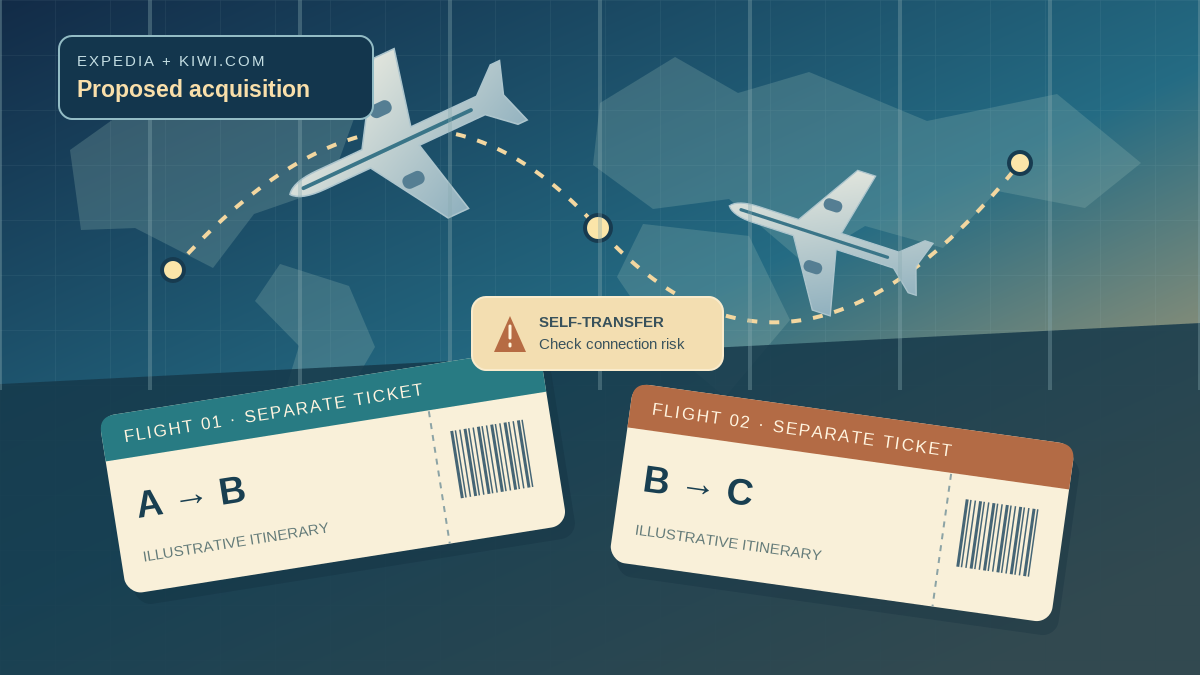
Seattle-based Expedia Group announced on November 25 that it has agreed to acquire Kiwi.com, a Czech flight-booking platform. The deal, for an undisclosed price, is expected to close during the first half of 2027 if the necessary closing conditions are met.
The acquisition is intended to expand Expedia's air-travel capabilities in Europe and support its business customers as well as its consumer booking platform. Existing bookings should not be assumed to have new protections as a result of the announcement: the deal has not closed, and the companies have not announced a blanket change to passenger contracts.
Why separate-ticket booking matters
Kiwi.com is known for virtual interlining, which can combine flights sold separately into a single proposed itinerary. A conventional through-ticket generally has arrangements for handling a missed connection caused by an earlier flight disruption, subject to the airline's conditions and applicable law. With separately ticketed flights, the onward airline may instead regard a passenger who arrives late as a no-show.
One linked journey. Check connection handling and baggage arrangements with the carrier.
Separate flight contracts. Check each ticket, baggage rules and any additional protection.
Kiwi's own guidance notes that self-transferring passengers may need to collect bags, leave the secure area and check in again. Some itineraries even require changing airports. Its optional disruption services can provide coverage in specified circumstances, but travelers should read the terms for their particular booking.
Calculator: compare the all-in cost of two itineraries
Enter totals for your entire travel party. The default fares, costs and risk assumptions are fictional. The calculator does not estimate actual delay probabilities or determine whether a claim is covered.
Separate-ticket upfront cost: $535.00
Upfront savings: $115.00
Illustrative risk-adjusted separate-ticket cost: $585.00
Risk-adjusted savings: $65.00
Separate-ticket cost in the modeled disruption: $1,035.00
Break-even disruption probability: 23.0%
Assumes one possible extra-cost event, with no modeled additional disruption expense for the through-ticket. Both itinerary types can incur disruption costs. Expected cost is not the maximum cost. Enter only the extra amount you expect to pay after any applicable reimbursement; coverage is not guaranteed. Inputs are processed locally by the page script.
When a cheaper itinerary becomes more expensive
In the example, two separate tickets cost $420 before baggage, transfers and optional protection. Those additions bring the total to $535. A $650 through-ticket therefore costs $115 more upfront. If the separate-ticket traveler assigns a hypothetical 10% chance to an unreimbursed $500 expense, the modeled expected additional cost is $50. That narrows the expected saving to $65.
But a traveler who actually faces the modeled disruption would need to spend $1,035 overall. An average financial advantage does not mean that every outcome is affordable. Someone who cannot fund a replacement ticket at short notice may reasonably prefer a more straightforward itinerary even when its initial fare is higher.
Four checks before booking a self-transfer
- Connection time: account for baggage collection, immigration, security, terminal transfers and the next airline's check-in deadline. No single connection duration works for every airport.
- Entry requirements: check whether collecting a bag or changing terminals requires permission to enter the country.
- Full price: compare baggage allowances, seat fees and any airport transport needed on each leg.
- Disruption terms: establish which events are covered, what documentation is required and whether you must contact the provider before arranging alternatives.
What happens next for Expedia and Kiwi?
General Atlantic, which invested in Kiwi in 2019, announced it has agreed to sell its shareholding as part of the transaction. Travel-industry publication Skift notes the proposed acquisition would add flight-combination technology to Expedia's wider travel distribution business.
The longer-term consumer effects remain uncertain. More flight combinations could create more choices, but prices, support arrangements and integration plans will depend on implementation after closing. Travelers booking now should compare the contracts and costs offered today rather than assuming future features will apply to existing reservations.
Sources & further reading
AI-assisted, source-based explainer. No live fares, airline contracts or individual coverage were independently tested. The calculator is a hypothetical cost model, not a forecast. See editorial standards for corrections.