EU records €36 billion goods trade deficit in third quarter
Eurostat’s latest release shows imports from outside the bloc exceeded exports, with energy products accounting for a substantial negative balance.
The latest figures
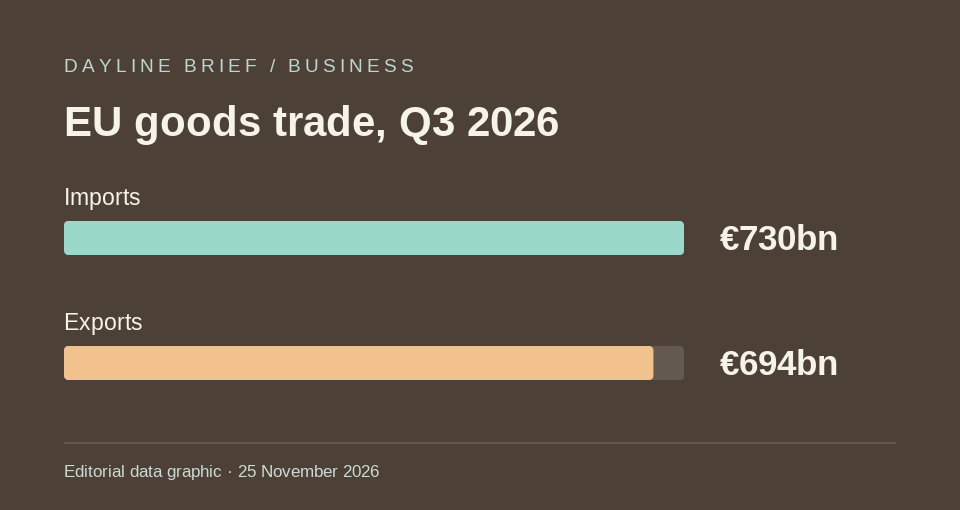
Eurostat reported on 25 November that the European Union imported €730 billion of goods from outside the bloc during the third quarter of 2026 and exported €694 billion. The difference produces a €36 billion deficit. The agency says that the bloc recorded a goods deficit in each of the first three quarters of the year, with the latest quarterly balance little changed from the preceding period.
Which categories drove the result?
The energy category alone recorded a negative balance of €96.3 billion. Chemicals and related products, by contrast, generated a €50.1 billion surplus. The agency also noted a reduced surplus in machinery and vehicles, around half the size of the previous quarter’s figure. These categories illustrate why a single total can conceal large differences in trade patterns.
Why imports and exports can both rise
Compared with the preceding quarter, export values increased by 1.8% and import values increased by 1.7%, according to Eurostat. The changes were about €12.0 billion and €11.9 billion, respectively. An increase in both flows need not produce a substantial change in the balance if the increases in euros are similar. The percentage growth rates alone are insufficient to establish the change in the deficit because the two starting values differ.
What the deficit does not measure
A trade deficit means that the measured value of imports exceeds exports. It is not the same thing as a government budget deficit, which compares public revenue with public spending. The latest release also concerns goods exchanged with countries outside the EU, rather than trade between EU members. Services such as software, tourism and consulting are not included in these figures. Nor does a larger euro value necessarily establish that more physical goods were exchanged: changing prices can affect trade values.
Putting the numbers in perspective
Using the published totals, the deficit amounts to roughly 4.9% of the value of imports for the quarter. That ratio provides an illustrative comparison of scale, not a measure of economic health. Assessing the broader implications would require additional data on services, trade volumes, production and prices. Future Eurostat releases may also revise earlier observations. The relevant question for subsequent reports is whether the overall balance and the individual categories move together or diverge further.
Sources & further reading
This AI-assisted, source-based brief reflects information available on 25 November 2026. It includes explanatory context, not firsthand reporting. See editorial standards for corrections.