Water bills are projected to rise 36% by 2030: what Britain’s utility reforms mean for households
The government's November 25 update outlines stronger oversight of water and energy services. Explore what the existing water bill projection means for your household budget.
Water customers in England and Wales have been facing a multiyear increase in charges as companies invest in their networks. A government statement published on 25 November has brought those costs back into focus, alongside plans to change how essential services are overseen.
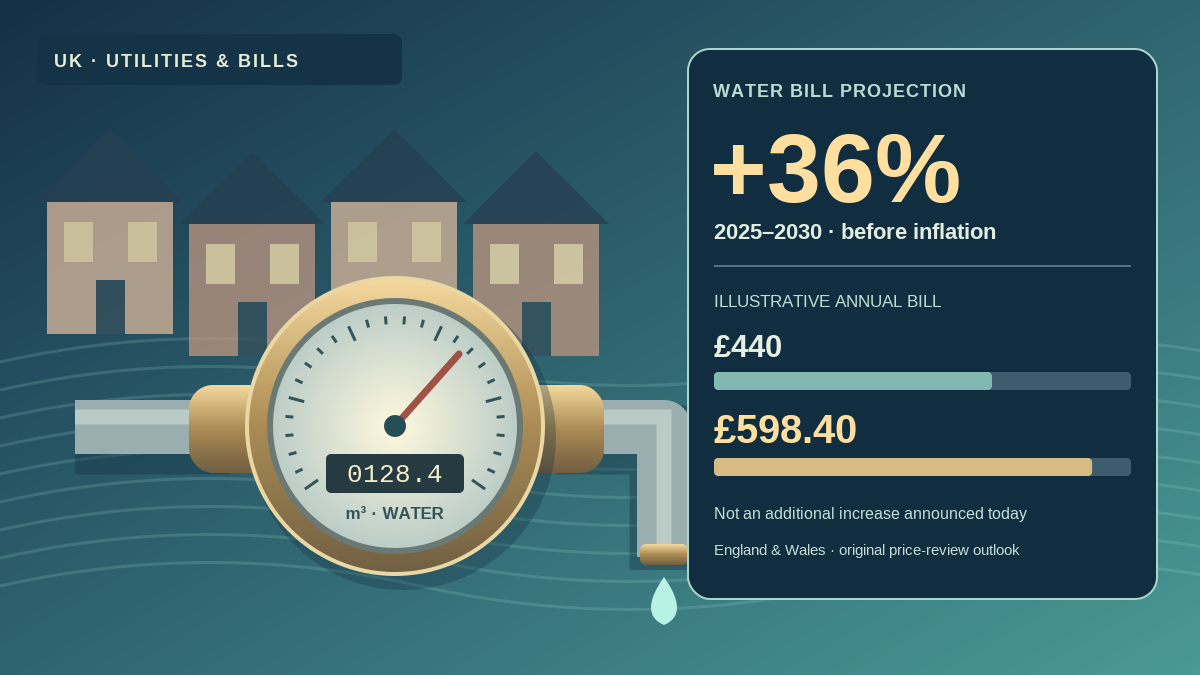
The Cabinet Office's update follows First Secretary of State Louise Haigh's address to the Confederation of British Industry on Monday, 23 November. It restates a projection that water bills will rise by 36% between 2025 and 2030. This is not an announcement of an immediate additional 36% increase.
What the 36% figure represents
Ofwat's 2024 price review set out a five-year investment programme for England and Wales worth £104 billion. Its original sector forecast implied an average increase of approximately £31 each year, excluding inflation. The total increase over the period was estimated at 36%. Actual bills depend on the company, household usage and other factors. Subsequent regulatory decisions may also affect individual companies.
For 2026/27, Ofwat separately reported an average increase of 5.4%, equivalent to £33. The annual figure and the multiyear projection describe different time periods. They should not be added together to estimate an individual bill.
Model a water bill increase
The following calculator applies an assumed percentage increase once to your chosen starting annual bill. To illustrate the original five-year forecast, enter your 2024/25 annual bill and 36%. If you enter a current bill instead, choose your own hypothetical future increase rather than treating the original 36% as a further scheduled rise.
Illustrative new annual bill: £598.40. Monthly equivalent: £49.87. Extra monthly cost: £13.20.
Scenario only, not a company tariff forecast. The starting amount and percentage are editable. Monthly amounts are annual costs divided by 12, not necessarily the actual instalments charged. No entries are transmitted.
How different starting bills would change
| Starting annual bill | After 36% rise | Extra per month |
|---|---|---|
| £300.00 | £408.00 | £9.00 |
| £440.00 | £598.40 | £13.20 |
| £600.00 | £816.00 | £18.00 |
| £800.00 | £1088.00 | £24.00 |
Illustrative arithmetic at the rounded 36% rate, excluding any additional inflation effects. These are not observed company bills.
What could change under the planned reforms?
Ministers intend to introduce a Water Bill in 2027, drawing on the Cunliffe review. The plan includes a single independent regulator and changes to the oversight of water companies. The government also wants to use measures such as wetland restoration where they can achieve environmental outcomes effectively, rather than relying exclusively on constructed infrastructure.
Separately, in September, the government announced that it intends to lift legal restrictions on its ability to acquire shares in major English water and sewerage companies. Removing that restriction would allow more options for intervention; it would not automatically transfer every company into state ownership. The September announcement specifically applies to England.
Why businesses disagree over the approach
The government argues that better coordination of infrastructure and regulation can reduce delays and costs. ITV's coverage of the conference reported that Haigh sought to reassure private investors that the policy does not require universal nationalisation. Conservative leader Kemi Badenoch expressed concern about increased political control of businesses, while Green leader Zack Polanski argued that the plans do not go far enough towards public ownership.
The financing question remains important regardless of the ownership model. Repairs, reservoirs, sewage treatment and other infrastructure have to be paid for. The eventual impact on customers will depend on investment costs, regulatory decisions, performance and the final policy design. Neither the speech nor the Cabinet Office update establishes a new household discount.
What to check on your next bill
Compare the annual cost and billing period with the previous statement, rather than relying solely on the amount taken by direct debit. If you have a meter, check whether the reading is actual or estimated, and compare the units of water used. If consumption is unexpectedly high, ask the company how to investigate possible leaks. For unmetered homes, ask whether moving to a meter would be suitable before committing.
If payment is difficult, contact your water provider about its social tariff and debt assistance arrangements. Ofwat says companies offer support for customers who struggle to pay, but qualifying rules and reductions vary. A proposed national reform is not a reason to postpone seeking help with a current bill.
The useful distinction for households is between existing price controls and proposed future reforms. Watch the next company-specific tariff notice and the eventual Water Bill instead of assuming that today's announcement changes what you owe.
Sources & further reading
AI-assisted, source-based explainer, not firsthand reporting or individual financial advice. The Cabinet Office update, keynote, September government announcement and ITV report were read directly. Ofwat's pages returned access errors and were checked through indexed extracts; individual company tariffs and subsequent determinations were not independently reviewed. The calculator and examples are original illustrations. See editorial standards for corrections.