Three English social landlords earn top rating: how to check yours and complain about poor service
New regulatory judgements put housing quality and tenant feedback in focus. Understand the C1 to C4 grading system and the steps for escalating an unresolved complaint.
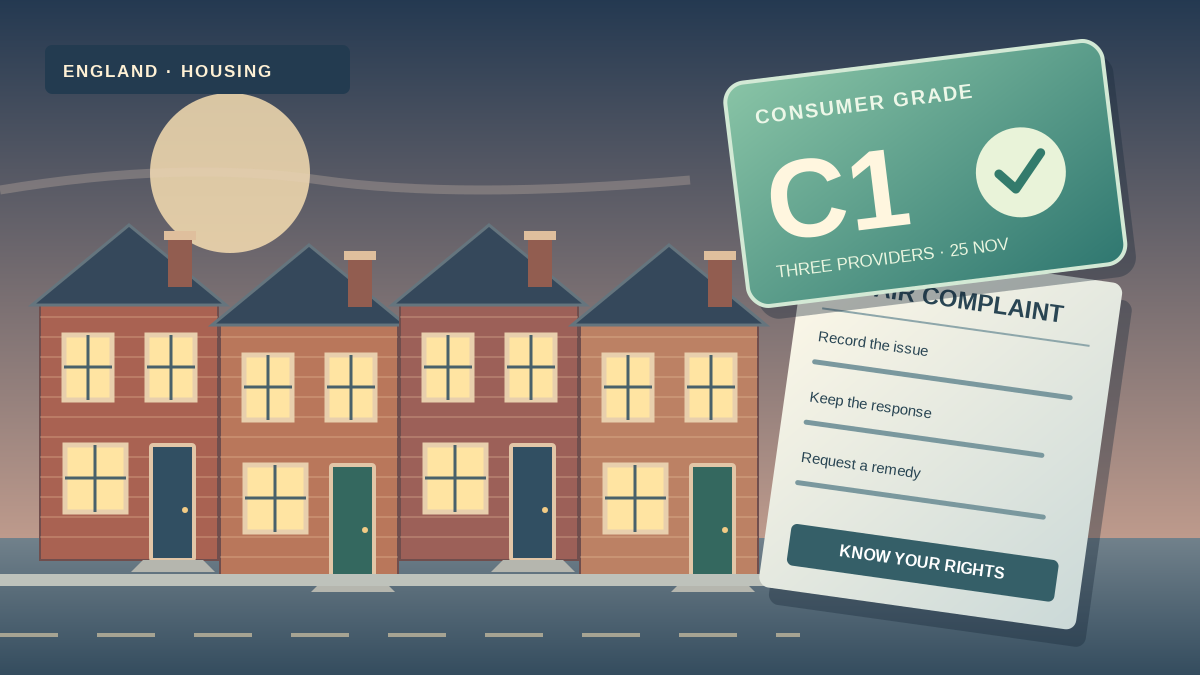
When a housing association earns a strong regulatory rating, what should that mean for someone waiting for a repair? The answer is more complicated than a single letter and number. England's Regulator of Social Housing (RSH) issued new judgements on 25 November 2026, awarding its highest consumer grade to three providers.
ForHousing Limited and New Forest District Council received C1 in their first consumer assessments. The Community Housing Group, principally operating in north Worcestershire, moved from C2 to C1. ForHousing, which has approximately 18,000 social homes in north-west England, also improved its governance rating to G1. Its financial viability grade remained V2.
What do the new ratings reflect?
Regulatory assessments highlighted maintenance and resident participation at ForHousing, repair and building safety performance at New Forest, and improvements in repairs and complaint management at The Community Housing Group. These assessments concern services across each organisation rather than certifying the condition of every individual home.
What does your landlord's C grade mean?
| Grade | Meaning in brief |
|---|---|
| C1 | Broadly achieving the consumer standards; problems still need to be identified and addressed. |
| C2 | Weaknesses exist and service improvements are required. |
| C3 | Serious deficiencies warrant substantial improvements. |
| C4 | Very serious shortcomings require fundamental changes. |
Source: RSH grading guidance, summarised. Financial viability (V) and governance (G) grades assess different matters.
Landlords managing fewer than 1,000 homes are not routinely assigned these grades, although serious regulatory concerns may result in a published judgement. An absent grade therefore does not necessarily indicate poor service. Check the date and scope of the assessment, not just its headline rating.
How widespread are serious shortcomings?
Source: RSH annual report 2025–26. C1 and C2 combined by subtraction. The denominator is graded large landlords, not all landlords or households. Percentages are rounded independently.
The report identifies overdue repairs, gaps in safety checks and insufficient resident engagement among the issues encountered during regulation. These are historical findings rather than an updated count of all landlords today.
What to do if your own landlord is not fixing a problem
Start by reporting the issue to your housing provider through its repair or service channel. If its handling of the report is inadequate, submit a formal complaint. Explain the problem, when it began, previous attempts to resolve it, its effects and the outcome you are seeking. Preserve a dated record of reports and responses.
The Housing Ombudsman's guidance sets out a two-stage procedure. Acknowledgement normally comes within five working days at each stage; the usual written response deadline is ten working days after stage-one acknowledgement and twenty working days after stage-two acknowledgement. Extensions may apply. These are complaint-handling deadlines, not the time allowed for all repairs. Report urgent hazards immediately rather than waiting for a complaint response.
Find the next step in your complaint
Report the issue directly to your landlord using its appropriate service channel.
Official complaint guidance and templates · When to contact the Ombudsman
Educational guide for social housing in England; it does not submit a complaint or collect personal information.
Which organisation can actually resolve your complaint?
The regulator assesses the performance of providers at an organisational level. The Housing Ombudsman handles individual disputes within its jurisdiction. If you want a specific repair carried out or a complaint reviewed, follow your landlord's procedure and the Ombudsman's guidance. Evidence of systemic failures may also be relevant to the regulator.
A C1 grade is not a reason to abandon a legitimate complaint. Equally, a C3 or C4 grade does not automatically entitle every resident to compensation. The facts of the particular case and the applicable duties determine what remedy may be appropriate.
Sources & further reading
- Regulator of Social Housing — new judgements, 25 November 2026 (includes links to individual landlord assessments)
- RSH — interpretation of regulatory grades
- RSH — annual report and accounts 2025–26
- Housing Ombudsman — complaint procedure
- Housing Ombudsman — when to request assistance
- GOV.UK — reporting problems with social landlords
- GOV.UK — roles of the regulator and Ombudsman
AI-assisted, source-based reporting, not firsthand reporting or legal advice. The regulator's announcement, grading guidance, annual report and Ombudsman complaint instructions were reviewed as retrieved page text. The chart is calculated from the published counts. See editorial standards for corrections.