£100 energy payment for 20 million households: who qualifies and when will it arrive?
New government guidance explains England’s January 2027 Household Energy Payment. Check your council tax band, payment route and key dates.
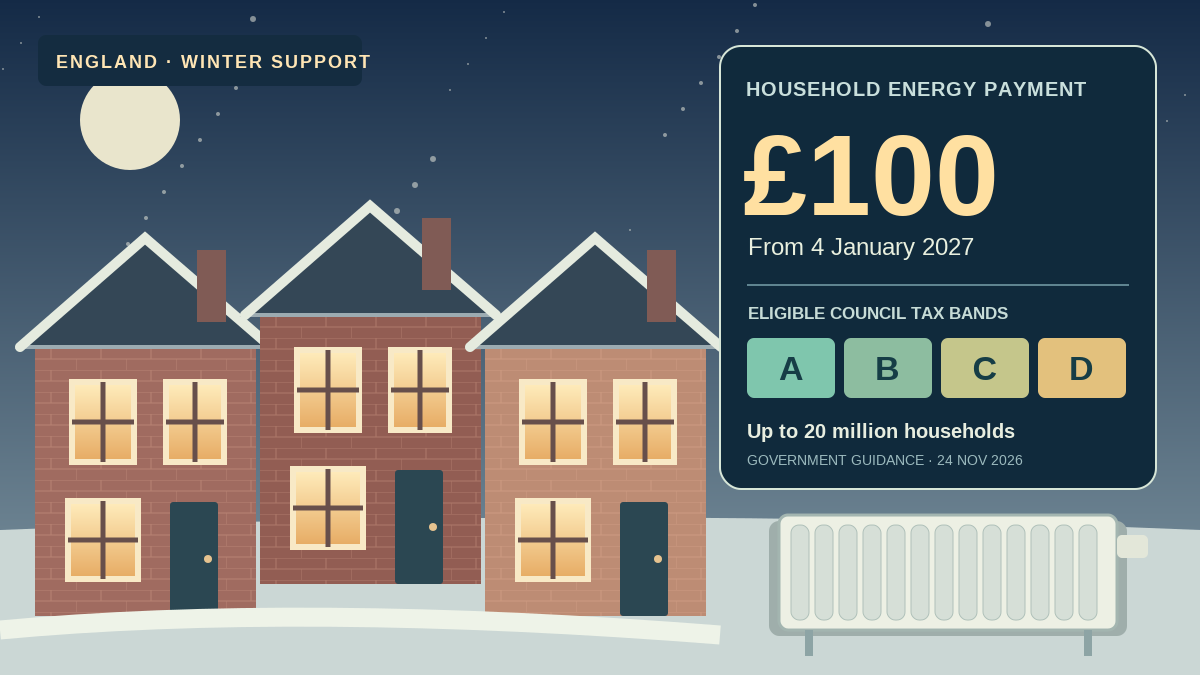
Millions of households in England are due a one-off £100 contribution towards winter energy costs. The payment was announced in the autumn Budget, but guidance issued on 24 November now explains how councils should deliver it.
Ministers estimate that up to 20 million households will benefit, with around 13 million expected to receive automatic bank transfers. The others may need to choose a payment method through their council. This is a household payment, not £100 for each adult.
Check the key dates
Do not assume that money will arrive precisely on 4 January. The government's delivery guidance sets an expectation that most payments will be completed by the end of March.
Which homes are covered?
Eligibility is primarily determined by council tax classification and whether the property is your main or only home in England. The central scheme covers bands A through D. A property valued in band E but reduced to D under the disabled band reduction scheme can also qualify.
Some households with no council tax bill remain eligible, including those receiving full local council tax support and certain exempt properties. Landlord-liable houses in multiple occupation generally fall outside the central scheme. Unbanded new homes and military accommodation have separate provisions.
Find your next step
This guide covers common situations in England only. It cannot establish entitlement, check council records or submit a claim.
Choose your circumstances to see the relevant guidance.
Your selections stay in your browser. Confirm your circumstances using the official factsheet and your council's website.
How far could £100 go?
The payment does not lower the unit price of energy or change the terms of your supply contract. Its practical value depends on your own costs. For example, if a household sets it aside to cover extra energy spending over four months, it provides £25 per month. If its monthly energy budget rises by £50, the same payment covers the equivalent of two months of that increase. These are illustrations, not forecasts of your bill.
| Illustrative monthly increase | Months covered by £100 |
|---|---|
| £10 | 10 |
| £20 | 5 |
| £25 | 4 |
| £40 | 2.5 |
| £50 | 2 |
| £100 | 1 |
Households should use their actual tariff, consumption and statements to plan winter costs. A direct debit may be different from the cost of the energy used during a particular month.
Protect yourself from payment scams
A genuine council may need payment information, which makes this scheme a plausible subject for impersonation attempts. Do not follow an unsolicited message straight to a form asking for financial details. Instead, locate your council using the official council finder and navigate to its payment guidance yourself. A payment does not require you to disclose your online banking password or security codes.
If you are struggling to afford heating but do not qualify, councils will administer a separate £100 million discretionary fund. Local criteria can differ. Scotland, Wales and Northern Ireland have their own arrangements; do not use the English eligibility guide as a decision on support elsewhere in the UK.
Sources & further reading
AI-assisted, source-based explainer, not individual benefits advice. The government announcement, household factsheet and council guidance were read directly; independent coverage was checked through its indexed extract. The decision guide and budget examples are original educational material. See editorial standards for corrections.