Canada adds C$10.7 million sockeye salmon project to Prince George hatchery
The Upper Fraser River conservation hatchery is expanding to support sockeye as well as Chinook salmon. Explore the construction timeline and how survival rates affect returning adult fish.
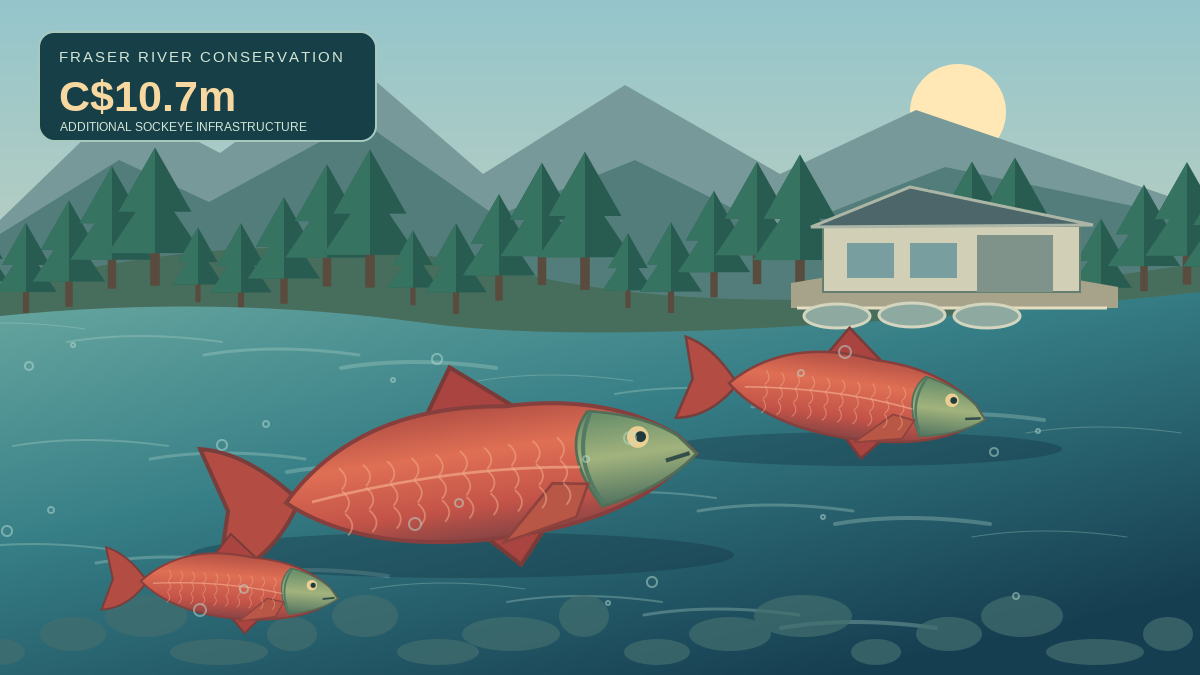
Canada and the Lheidli T'enneh First Nation announced on November 25 that a salmon conservation facility under construction in Prince George, British Columbia, will gain dedicated sockeye infrastructure worth C$10.7 million. The project was previously designed to focus on vulnerable Chinook populations in the Fraser River watershed.
The expansion includes facilities for raising young sockeye indoors and outdoors, as well as egg-incubation equipment. Construction of the new component is expected to finish by spring 2028. The first eggs could arrive later that year. These are planned milestones, not confirmation that production has begun.
The project in context
Source: Fisheries and Oceans Canada, August 25 and November 25 announcements. Contract values are not a complete lifetime cost estimate.
The federal department will own and operate the facility in collaboration with Lheidli T'enneh. Chief Dolleen Logan emphasized the importance of salmon to the Nation's cultural life and stewardship responsibilities. The sockeye work will be added to the contract already awarded to IDL Projects through an amendment; it was included as an option during the original tender process.
How a conservation hatchery works
Unlike a farm supplying fish for immediate sale, a conservation hatchery can raise young fish to release into the environment. Fisheries and Oceans Canada describes a process in which eggs from local salmon are fertilized and incubated in controlled conditions. Young fish then grow under managed conditions before release at the appropriate life stage.
Pacific salmon have complex life cycles. Many populations migrate downstream into the ocean and eventually return to freshwater to reproduce. A hatchery can influence early development, but cannot control every condition the fish encounter after release.
Interactive: what does a survival rate mean for a salmon cohort?
Explore a simplified model for one release cohort. The starting quantity of 100,000 juveniles and both survival assumptions are invented teaching examples. They are not the planned sockeye output or measured Fraser River survival rates.
Ocean entrants: 50,000
Expected returning adults: 2,000
Release-to-return survival: 2.00%
The bar represents expected adults as a share of released juveniles. The model multiplies two conditional survival rates; it excludes differences in age at return, genetic fitness, environmental variability, density effects and subsequent reproduction. It is not a population forecast. Inputs are processed locally by the page script.
Why more releases do not necessarily mean recovery
In the fictional example, half the juvenile fish reach the ocean and 4% of those eventually return. That produces a combined survival rate of 2%, not 54%. If the second rate falls to 1%, the expected number of returning adults declines from 2,000 to 500, even though the number released stays unchanged.
Conservation success involves more than maximizing the number of juveniles released. Researchers also need to consider the health of wild populations, genetic diversity, whether returning adults successfully reproduce, and the effects of hatchery fish on natural ecosystems. DFO's enhancement guidance calls for population-specific objectives and reassessment when activities do not achieve their goals.
What happens next?
The initial construction award in August described capacity for 400,000 juvenile Chinook annually. That figure does not establish the future sockeye capacity, which was not quantified in the November announcement. Nor should it be treated as an annual adult-return target.
The most useful measures to watch after construction are the actual numbers and life stages of fish released, long-term adult return monitoring and evidence of improved wild-stock conditions. Habitat protection and restoration remain important alongside hatchery operations: returning fish need suitable freshwater habitat to complete their life cycles.
Sources & further reading
- Fisheries and Oceans Canada — November 25 sockeye expansion announcement
- Fisheries and Oceans Canada — August 25 original construction award
- DFO — how hatcheries and spawning channels operate
- DFO — wild Pacific salmon conservation policy
- CKPG Today — August reporting on British Columbia hatchery contracts
AI-assisted, source-based explainer. Construction details are based on official announcements, not an independent site inspection. Sockeye production capacity and actual survival rates are not established by the latest release. The interactive model is educational and uses hypothetical inputs. See editorial standards for corrections.