Canada's child-care workforce study finds 1 in 4 workers left their employer within a year
New Statistics Canada research examines educator retention and its relationship with pay and benefits. Compare the annual cost of higher wages with potential savings from lower turnover.
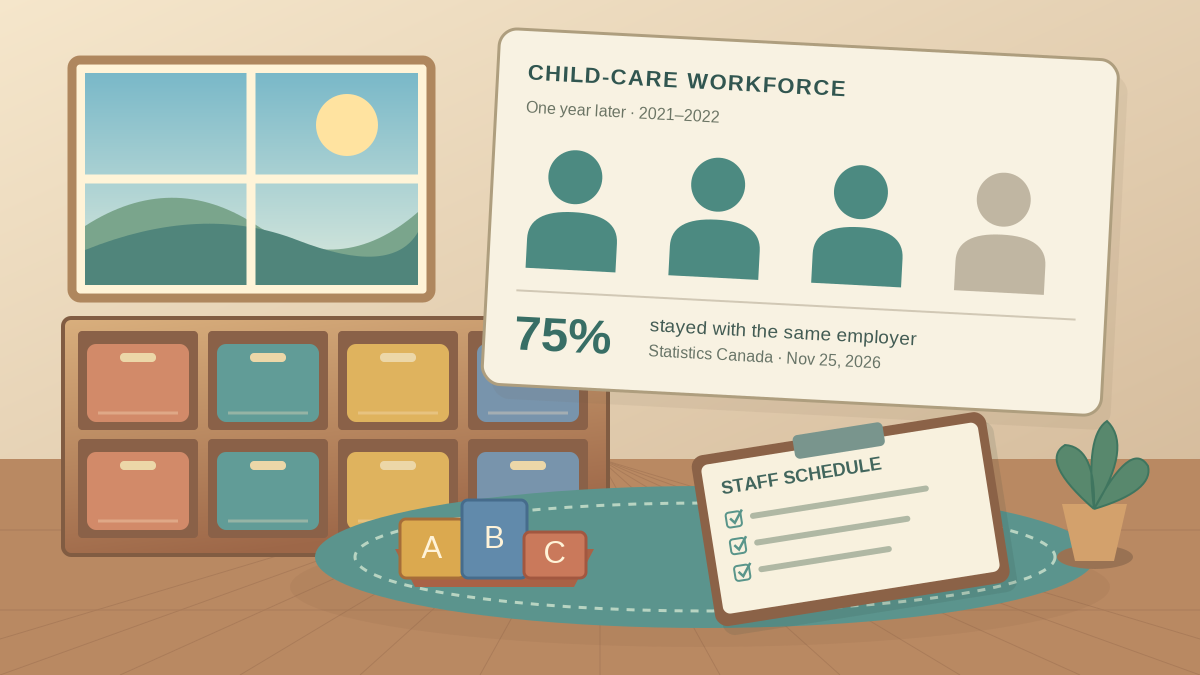
A new Statistics Canada study published on November 25 finds that 75% of early childhood educators and assistants employed in child-care services in 2021 were still working for the same employer the following year. In total, 83% remained in the industry. Researchers linked census occupation information with employment and earnings records.
The findings offer a historical look at workforce stability, rather than a measurement of departures during 2026. For providers, they highlight the importance of considering staffing costs as a whole, rather than treating the hourly wage as the only expense.
Pay, pensions and retention
Source: Statistics Canada, 2021–2022 linked data, published November 25, 2026. Annual earnings are expressed in 2024 Canadian dollars. All bars start at zero. Groups overlap; these are descriptive associations, not estimated effects of a pay rise.
Among workers who left the industry, elementary and secondary schools were the most common subsequent industry, accounting for 22% of leavers. The study also found associations between retention and employment characteristics including earnings, union dues and pension contributions, after accounting for other measured factors.
These results do not establish how much an individual employer would reduce turnover by raising wages. Annual earnings can reflect hours worked and time spent in employment, not just the hourly rate. Longer-serving employees and those with more stable schedules may differ from employees who leave in ways the data cannot fully capture.
Why a vacancy is more than a recruitment expense
When an experienced employee leaves, the cost may extend beyond posting a vacancy. Management time spent interviewing candidates, paid orientation, temporary coverage and training can all affect a provider's finances. A vacancy can also make it difficult to maintain planned services within applicable staffing requirements.
However, a wage increase is a recurring commitment. Paying every employee more to prevent a small number of departures may cost more than the direct savings from fewer hires. That does not make the wage increase a bad decision: service continuity, staff well-being and fairness can matter even if the initiative does not immediately pay for itself.
Calculator: compare a wage increase with turnover savings
Use your own payroll and recruitment records. The defaults are fictional examples, not wages or costs estimated by Statistics Canada. The expected departures after changes are your scenario, not a prediction based on the study.
Additional annual payroll: $40,320.00
Potential annual turnover savings: $16,000.00
Net additional annual cost: $24,320.00
Break-even: 6 departures avoided per year (more than the 5 baseline departures).
Simplified annual cash-cost comparison. Excludes tax credits, changes in enrolment revenue, productivity, inflation and other benefits. Use non-overlapping costs to avoid double counting. Inputs are processed locally by the page script.
How to make a realistic replacement-cost estimate
Start with the actual advertising and screening expenses of previous hires. Add management hours spent on interviews and the incremental cost of temporary cover. Include paid training and overlap time where they would not otherwise be incurred. Keep ordinary ongoing wages out of the replacement-cost estimate if they are already included in payroll.
Next, separate departures from the number of people employed. A single position may experience more than one departure in a year. Measure the number of departures over the same period as the payroll comparison. Distinguish voluntary resignations, retirement and other changes, rather than assuming that any wage increase could prevent all departures.
What the example shows
A C$1 hourly increase for 20 employees working 1,800 paid hours each costs C$36,000 before additional employer costs. Adding an illustrative 12% payroll burden raises that amount to C$40,320. Preventing two departures worth C$8,000 each would offset C$16,000, leaving C$24,320 in additional annual costs.
Try more conservative and more optimistic scenarios. Even preventing all five original departures would not cover the full payroll increase at these assumed costs. A provider may still choose to raise pay, but should budget for the remaining expense rather than counting on recruitment savings alone.
Questions parents and employees can ask
Families comparing providers can ask how staff transitions are handled, how children are introduced to new educators and what arrangements exist when regular staff are absent. Employees comparing job offers should consider predictable hours, paid leave, pension arrangements and opportunities for professional development alongside advertised wages.
Providers should check current provincial requirements and funding agreements before altering staffing or compensation. The national research does not specify the conditions of individual centres. Its value is in prompting a broader discussion of the costs and benefits of a stable workforce.
Sources & further reading
AI-assisted, source-based explainer. The research describes 2021–2022 outcomes and is not a current turnover survey. The primary study was reviewed through retrieved text extracts; a separate direct page fetch failed. The cost model is original and illustrative, not individualized financial or employment advice. See editorial standards for corrections.