Canada introduces a 50% tariff on above-quota canned vegetable imports: what it means for grocery shoppers
A new import quota takes effect December 1. Learn how it differs from a blanket tariff and compare grocery prices by weight before buying.
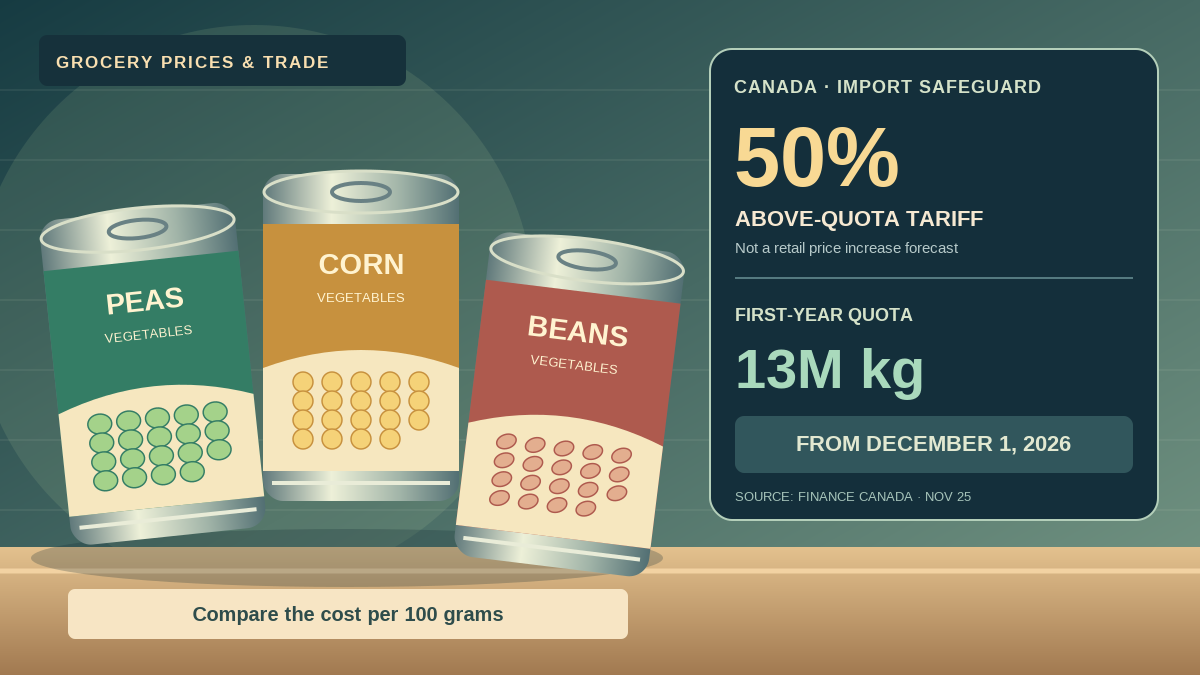
Canadians buying canned vegetables could see changes in the selection or prices of imported products over the coming months. But the headline tariff rate announced by Ottawa on November 25 is not a prediction of what shoppers will pay.
Finance Canada has announced a tariff-rate quota on certain imported canned vegetables, effective December 1, 2026, through June 17, 2029. The measure follows an investigation into the harm caused by increased imports to Canadian producers.
How the new quota works
Initial quota volume. Covered imports within their applicable quota do not incur the new safeguard tariff. Above-quota imports face a 50% rate.
Conceptual illustration of the distinction between within-quota and above-quota goods. The coloured proportions do not represent actual imports.
The quota will expand to slightly more than 13.5 million kilograms over the life of the measure, while the additional duty will fall to 40%. Some origins are exempt, including Mexico, Chile, Israel, Colombia, Korea, Panama, Peru and eligible developing countries. Separate allocations are reserved for imports from the United States, European Union and Thailand. Importers should check the applicable origin and quota rules rather than relying on a single nationwide threshold.
Why Ottawa is changing the safeguard
In June, the government introduced a temporary 10% surtax on certain canned vegetables. Global News reported at the time that Ottawa viewed it as a way to address immediate difficulties faced by domestic producers. The Canadian International Trade Tribunal submitted its findings in September, and subsequent independent reporting covered its recommendation for a longer-term quota system.
November's decision replaces the temporary safeguard. A separate exclusion inquiry is due to begin by February 1, 2027, allowing interested parties to seek exceptions for particular goods that lack a Canadian supply or viable domestic production plans.
The government intends the measure to support domestic processing capacity and food security. The potential trade-off is that restrictions could raise importers' costs or reduce the available variety of some imported foods. The announcement does not quantify the eventual effect on supermarket prices.
Why a 50% tariff is not a 50% increase at checkout
Imagine an above-quota shipment with a customs value of $1 per can. A 50% safeguard duty on that value would add 50 cents per can, before other duties and costs. If the previous shelf price was $2, passing that entire extra 50 cents to shoppers would increase the price to $2.50, or 25%. This is a simplified example against a zero-safeguard baseline, not a forecast or a comparison with the actual previous tariff.
Retail prices also reflect freight, wholesale margins, packaging, store costs, exchange rates and competition. Importers might change suppliers, negotiate prices, use available quota or absorb some of the cost. Domestic goods and exempt imports do not automatically face the additional safeguard duty. Check the actual price tag rather than assuming all products in the aisle will become more expensive.
Compare two cans by price per 100 grams
A smaller can can appear cheaper without offering better value. This calculator uses Canadian dollars and the weights you enter. For products with liquid, use the same weight basis for both products; drained weight is useful if you discard the liquid and it is listed on both labels.
Can A: $0.450 per 100 g. Can B: $0.424 per 100 g. Can B has the lower unit price (5.7% less).
Fictional example prices, not current supermarket quotes. Results exclude any additional charges. Calculations run locally in your browser.
What households and small food businesses can do
Keep a short list of frequently purchased products and compare the unit cost on successive shopping trips. Consider domestic brands and frozen vegetables where they meet the same cooking needs. Frozen products have different storage requirements, and canned products may offer a longer unrefrigerated shelf life. A bulk purchase only saves money if you can use the contents before they deteriorate.
Restaurants and small retailers can request updated quotes from suppliers and ask whether those quotes include all applicable import charges. Do not assume that the same country of origin or product description guarantees the same duty treatment for every shipment. Consult the final implementing rules and professional customs advice if you import directly.
For now, the verified change is the import policy and its scheduled start date, not a universal increase in grocery bills. Watch actual unit prices and supplier notices as the new rules take effect.
Sources & further reading
- Department of Finance Canada — announcement, November 25, 2026
- Canadian International Trade Tribunal — September 9 inquiry report announcement
- Department of Finance Canada — provisional safeguard, June
- Global News — June reporting on the temporary tariff
- The Wall Street Journal — September reporting on the tribunal's recommendation
- Tax & Trade Blog — November 2 analysis of the tribunal's findings
AI-assisted, source-based explainer, not firsthand grocery reporting or customs advice. Today's Finance Canada release and the tribunal's September announcement were reviewed directly. Independent coverage of the earlier provisional measure and tribunal recommendations was checked through indexed extracts; no independent report of today's final announcement was located during research. The implementing customs order was not independently reviewed. The prices and calculations are illustrative. See editorial standards for corrections.