Britain’s energy price cap to rise by 26% in January 2027
Ofgem’s new rates take effect on 1 January. Here is what the £2,166 annualised figure means for households and how to estimate your own bill.
What is changing?
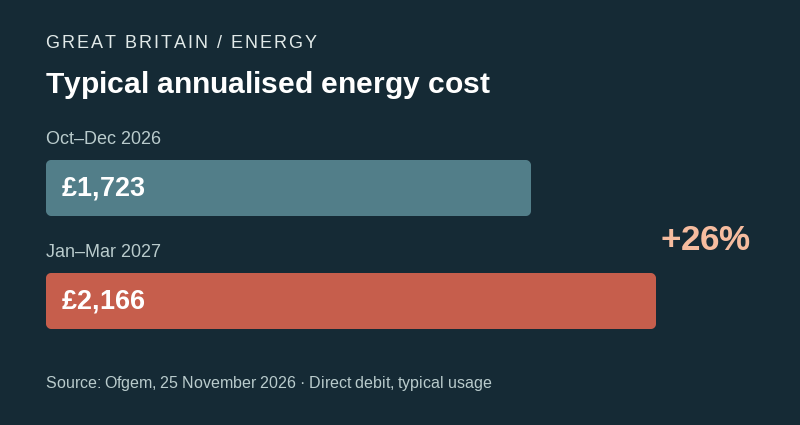
Great Britain’s energy regulator Ofgem announced on 25 November that its price cap for January to March 2027 will be 26% higher than the current level. The representative annual cost for a dual-fuel household using direct debit goes from £1,723 to £2,166. Ofgem attributes the increase to higher international gas prices associated with conflict in the Middle East.
Who is affected?
Ofgem estimates that roughly 20 million households use variable tariffs covered by the cap. Customers with fixed-rate deals generally retain their agreed prices until their contracts end. The regulator also reports a government plan for £100 of bill support from January for around 20 million households.
What will energy cost per unit?
The regulator’s published average direct-debit rates for England, Scotland and Wales are 32.69p per kWh of electricity and 10.96p per kWh of gas. Daily standing charges average 54.77p and 29.65p respectively. Electricity figures exclude VAT under the temporary government measure; gas figures include 5% VAT. Local rates can differ.
How to estimate your own bill
For illustration, a household using 250 kWh of electricity and 1,000 kWh of gas over 31 days would incur approximately £217.50 at those average rates, before any credits or discounts. The calculation is £81.73 for electricity consumption, £109.60 for gas consumption and £26.17 in combined standing charges. A larger household or a colder month could cost more.
The headline £2,166 is not a ceiling on what a household can spend, nor a promise that rates will stay unchanged for a year. It is an annualised comparison using typical consumption. The next cap announcement, for April to June 2027, is scheduled by 23 February.
Sources & further reading
This AI-assisted brief reflects the published information available on 25 November 2026. The example is our own illustrative calculation, not a quote for a particular household. See editorial standards for corrections.