Black Friday cyber risk: why retailers need a backup plan before the biggest shopping weekend
New insurance industry data highlights a November spike in ransomware and gaps in retail cyber cover. Estimate the cost of a shop outage and review practical protection measures.
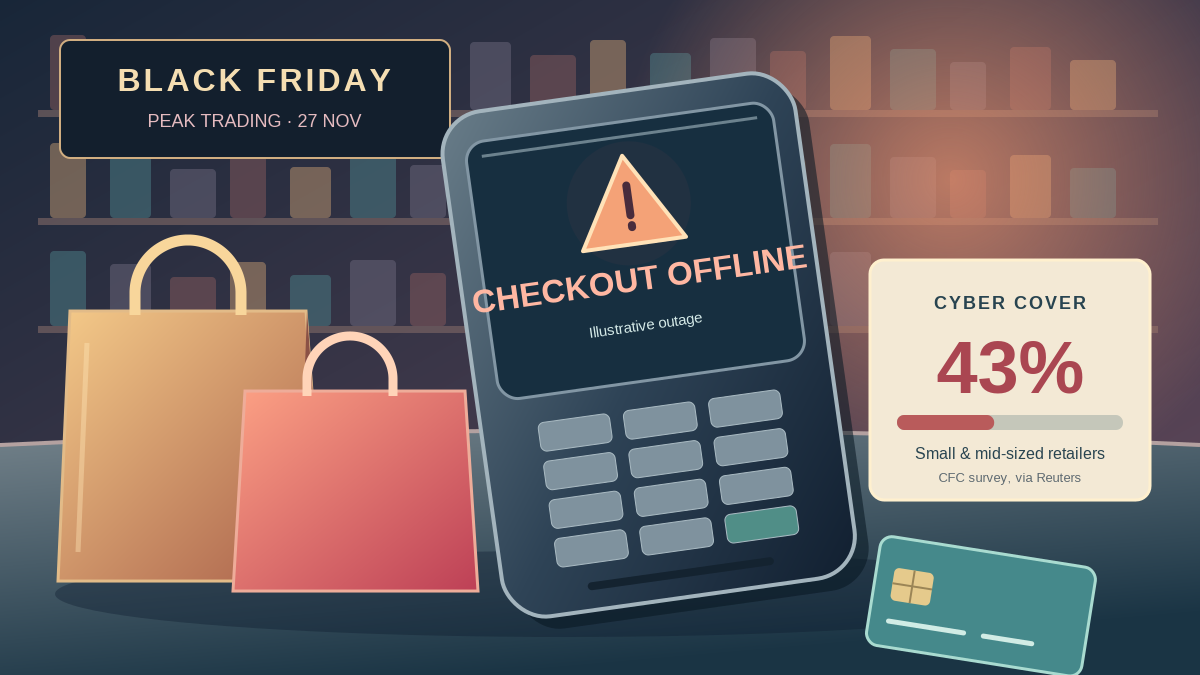
A broken checkout during an ordinary Tuesday may be an inconvenience. The same failure on Black Friday can turn a successful advertising campaign into a financial problem. With the shopping event falling on 27 November this year, online merchants and physical retailers have little time left to check how they would handle an interruption.
Reuters reported on 25 November that insurer CFC's claims records indicate a 50% November increase in ransomware frequency across retail, leisure and hospitality relative to the monthly average. Its reporting also highlights comparatively low adoption of cyber insurance among smaller retailers.
How retail compares with other sectors
Source: CFC figures as reported by Reuters, 25 November. These are survey figures, not a census or a measure of an individual company's chance of an attack.
Separate monitoring by security vendor Darktrace found that daily detections of Black Friday-themed phishing emails from 1 to 21 November were more than 13 times their October level. This is a change in detections within the vendor's monitoring data, not a count of successful intrusions or proof that every business is experiencing the same surge.
Why an outage costs more than missed sales
When a checkout stops accepting payments, some customers will return later, while others will buy elsewhere. A business may also incur extra staffing costs, refunds, specialist recovery expenses and lost advertising spend. The amount of revenue interrupted is not the same as profit lost: a sale that never takes place may also avoid the cost of stock and fulfilment.
Estimate the financial exposure of an interruption
The following scenario tool compares expected sales during an outage with the portion that can be recovered later. It uses your contribution margin after variable costs, plus additional incident expenses. Enter amounts in pounds, dollars or another currency consistently.
Retail downtime cost calculator
Interrupted sales: 6,000. Unrecovered sales: 4,500. Estimated contribution loss plus extra expenses: 3,300.
Hypothetical scenario only. Assumes constant sales per hour, unchanged margins and no additional cost to recover sales. Avoid counting the same expense twice. Excludes insurance recoveries, longer-term reputational damage and other unlisted losses. Entries stay in your browser.
Five priorities before the sales rush
- Confirm that backups of important order and inventory data can actually be restored, including a copy protected from compromise of the main systems.
- Protect privileged accounts with strong multi-factor authentication, preferably phishing-resistant methods where available.
- Apply necessary security updates with a tested deployment and recovery plan.
- Verify unusual supplier payment changes through a previously established contact method.
- Give staff a clear escalation contact and an approved way to keep serving customers during a technology failure.
These measures reflect guidance from the US Federal Trade Commission and the UK's National Cyber Security Centre. A fallback must still protect customer information: do not record card credentials in informal documents or bypass a payment provider's security requirements.
Does cyber insurance cover a lost Black Friday?
Not necessarily. The contract matters. Review whether business interruption is included, whether a waiting period or deductible applies, how losses are calculated, and whether an outage at a third-party technology supplier is covered. Ask who must be notified and which incident-response expenses require approval. The NCSC's insurance guidance explains the different kinds of protection available.
If you discover an actual incident, activate your response plan, contact qualified technical support and follow applicable notification requirements. Insurance cannot restore a checkout by itself. The most useful preparation is to know which services the business depends on and have a tested way of recovering them before peak demand arrives.
Sources & further reading
- Reuters — retail cyber risk and insurance, 25 November 2026 (syndicated full text)
- Insurance Business — CFC retail insurance survey, 24 November
- Darktrace — Black Friday phishing detection analysis, 24 November
- FTC — cybersecurity for small businesses
- NCSC — understanding cyber insurance policies
- NCSC — backing up business data
AI-assisted, source-based explainer, not firsthand reporting or individual insurance advice. Reuters was reviewed through its syndicated full text; Darktrace and FTC pages were read directly. NCSC guidance was checked through indexed extracts. CFC's original survey dataset was not independently available. The calculator is an illustrative estimate. See editorial standards for corrections.