Australia’s 30% discretionary trust tax clears Senate hurdle: what family businesses should review
A Labor–Greens agreement advances the proposed minimum tax on discretionary trusts. Understand non-refundable tax offsets, key dates and questions to discuss with your accountant.
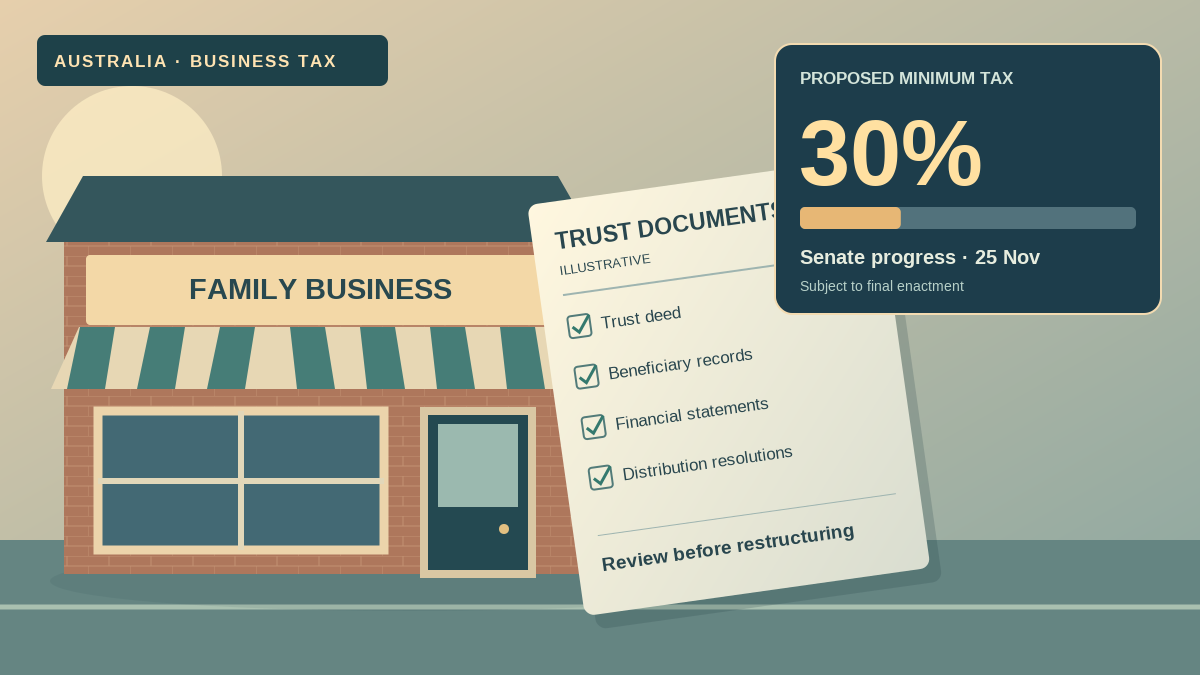
Australian families that operate a business through a discretionary trust have a clearer indication of where tax policy is heading. On 25 November 2026, the Greens announced an agreement to support Labor's minimum-tax legislation. Independent coverage by SBS reported that the deal would give the government the Senate support it needed.
The Senate passed the main bill with amendments, according to a same-day update from accounting firm PRATT Partners. Its companion rates bill passed both houses. The amended main bill still requires agreement from the House of Representatives before assent. The announcement should therefore not be read as an instruction to change this year's tax return.
What the 30% proposal actually means
A discretionary trust can give its trustee discretion over which eligible beneficiaries receive income or capital, subject to the trust deed and law. Under the proposed regime, the trustee of a covered trust would pay a minimum tax on the relevant taxable income. Eligible non-corporate beneficiaries could claim a non-refundable credit for the trustee's tax attributable to their share.
Non-refundable is the crucial distinction. A credit may reduce an eligible beneficiary's income tax liability but does not itself generate a refund when the credit exceeds that liability. Corporate beneficiaries are generally excluded from this proposed credit. The practical outcome depends on the type of income, beneficiaries and applicable exceptions.
Illustrate the offset mechanism
The following examples assume a fully covered amount of A$100,000 and an eligible individual beneficiary with an attributable A$30,000 credit. The assumed pre-credit income tax is fictional, not a calculation of Australian personal tax brackets.
| Pre-credit tax | Credit used | Additional tax | Unused credit |
|---|---|---|---|
| $20,000 | $20,000 | $0 | $10,000 |
| $30,000 | $30,000 | $0 | $0 |
| $40,000 | $30,000 | $10,000 | $0 |
In the first example, the unused A$10,000 is not returned to the beneficiary under the assumed non-refundable offset. In the third example, the credit does not eliminate all income tax. The purpose of the comparison is to explain the offset, not predict an actual tax assessment.
Interactive non-refundable credit illustration
Credit used: $20,000.00. Additional tax: $0.00. Unused credit: $10,000.00.
Arithmetic illustration only, not a tax calculator. It assumes a valid non-refundable credit applied against eligible tax. It excludes other offsets, levies, ordering rules, exceptions and trust-level calculations. Inputs remain in your browser.
Dates to put in your planning calendar
These dates describe the published proposal and should be checked against the final legislation. Some news coverage describes the impact in the 2029–30 financial year; that is not the same as establishing a revised commencement date. The ATO and October professional guidance specify 1 July 2028.
Why the policy is contested
Labor and the Greens argue that the change limits opportunities to reduce tax through discretionary income allocation. As part of the agreement, the Greens also secured a commitment concerning the tax advantage for privately operated jets and further charitable-sector oversight. Business groups have raised concerns about compliance expenses, cash flow and the cost of reorganising established structures. SBS reported that the opposition rejected the proposal over concerns about business impacts.
What to bring to an accountant
Rather than transferring assets immediately, gather your current trust deed and amendments, recent financial statements and tax returns, distribution resolutions, beneficiary details and any associated company records. Prepare a list of the assets held and any loans or guarantees that might be affected by a structural change.
Ask a registered tax agent whether the trust falls within the proposed scope, how the credit would work for its actual beneficiaries, and whether any exclusion or transition provision applies. A potential rollover for income tax purposes does not establish that a restructure is free of state duties, legal costs or other consequences. Business succession and asset protection may also be affected. Compare the full cost of any change before making a decision.
The immediate news is the parliamentary breakthrough. The eventual financial impact on an individual family remains a separate question that requires the enacted rules and the family's own circumstances.
Sources & further reading
- Australian Taxation Office — proposed minimum tax, updated 3 November
- Australian Greens — agreement announced 25 November
- SBS / AAP — independent reporting, 25 November
- PRATT Partners — parliamentary progress, 25 November
- CPA Australia — October bill analysis
- ATO — trustees and beneficiaries
- Independent Financial Adviser — industry concerns and transition provisions, 19 November
AI-assisted, source-based explainer, not individual tax or legal advice. The Greens' statement and SBS coverage were reviewed directly. ATO and professional guidance were checked through indexed extracts. Treasury and parliamentary pages were blocked during research, and the PRATT Partners page could not be opened directly; its indexed legislative update was used with that limitation. Final amended legislation and assent were not independently verified. Examples are fictional arithmetic illustrations. See editorial standards for corrections.